
National Pride: Japan and the Quest for the Wrestling World Cup
Vertical Bison | MP
National Pride: Japan and the Quest for the Wrestling World Cup
By Noah Leatherland
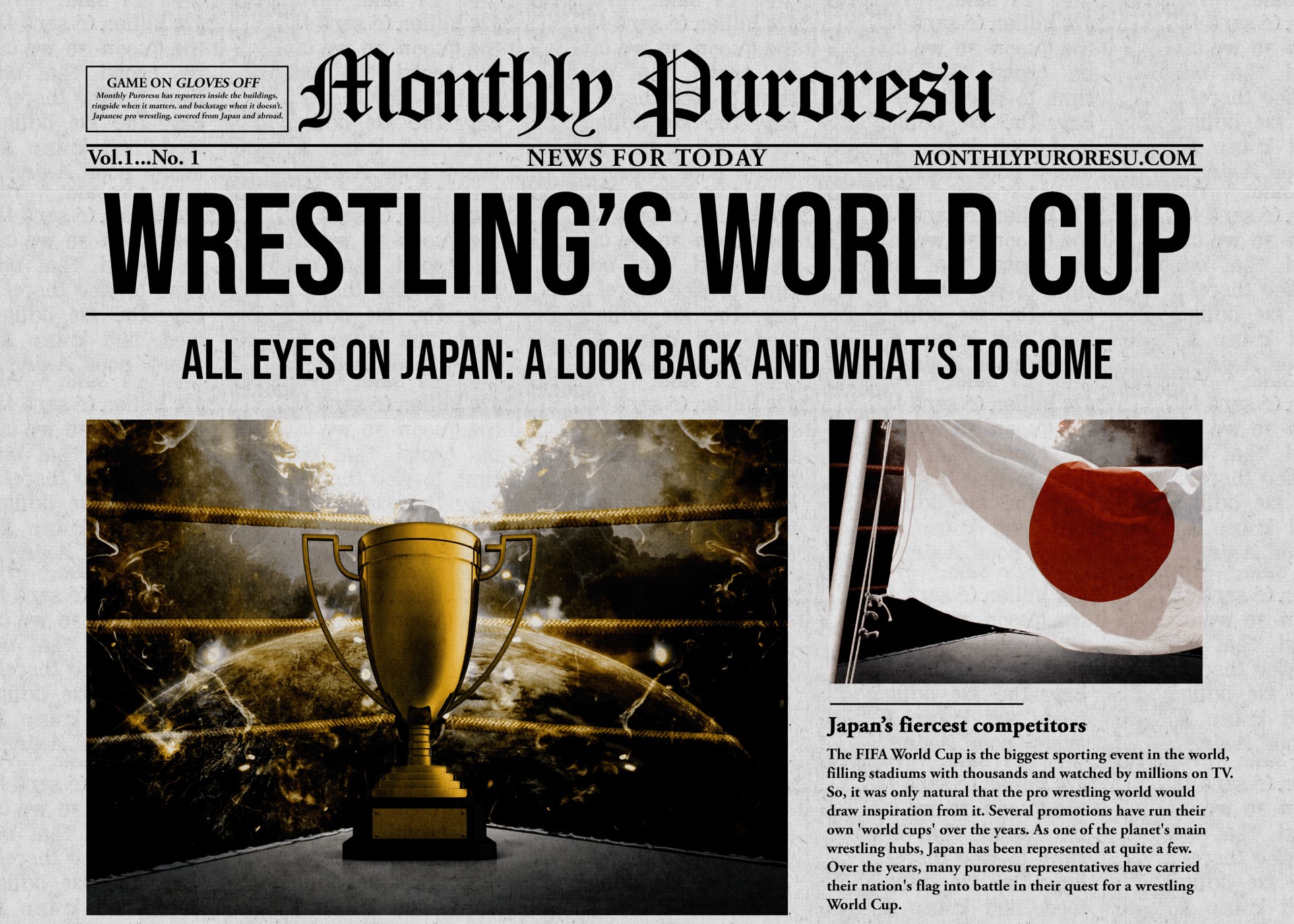
The FIFA World Cup is the biggest sporting event in the world, filling stadiums with thousands and watched by millions on TV. So, it was only natural that the pro wrestling world would draw inspiration from it. Several promotions have run their own ‘world cups’ over the years. As one of the planet’s main wrestling hubs, Japan has been represented at quite a few. Over the years, many puroresu representatives have carried their nation’s flag into battle on their quest for a wrestling World Cup.
In December 1995, World Championship Wrestling marketed that year’s Starrcade as ‘The World Cup of Wrestling’. Rather than gathering wrestlers from several nations, Starrcade featured a seven-match series pitting wrestlers from WCW against those from New Japan Pro Wrestling. While none of Japan’s soccer managers had managed to lead their teams to World Cup glory yet, Sonny Onoo hoped to do just that, being in the corner of every NJPW star at Starrcade. NJPW quickly drew blood in the series thanks to their excellent junior heavyweights. In the opening bout, Jushin Thunder Liger defeated Canada’s Chris Benoit, aided by some distraction at ringside. NJPW doubled their lead right away, as the reigning IWGP Jr. Heavyweight Champion Koji Kanemoto picked up a win against Germany’s Alex Wright. It was a rematch from that summer’s Best of the Super Juniors, with Kanemoto having Wright’s number on both ocassions.
NJPW started the stumble thereafter. Masahiro Chono was up next, facing off against Lex Luger. Chono fell to the Torture Rack, giving WCW their first point of the night. Then, Masa Saito came up against the WCW World Television Champion, Johnny B. Badd. Saito ended up dumping Badd over the top rope, which resulted in a DQ according to WCW’s rulebook, squaring the series up at 2-2.
NJPW’s juniors proved their worth once again. Shinjiro Otani had defeated Eddie Guerrero (under the Black Tiger mask) in that year’s BOSJ. He replicated that win at Starrcade, putting NJPW ahead once again.
Hiroyoshi Tenzan was the next NJPW star to head to the ring, billed simply as ‘Tensan’ on the WCW broadcast. He came up against the WCW World Heavyweight Champion, “Macho Man” Randy Savage. Tenzan joined the long list of stars that had felt the impact of Savage’s flying elbow drop, with Savage pulling the score back to 3-3.
The 1995 World Cup of Wrestling came down to the seventh match in the series. For NJPW, Kensuke Sasaki stepped up to the plate, the WCW United States Championship around his waist. WCW saved their biggest gun for the final match, with Sasaki coming up against the man called Sting. The Scorpion Deathlock proved just too deadly, with Sasaki forced to submit in the middle of the ring. Sting was joined by his teammates and held the World Cup trophy aloft. The Nashville crowd burst out into chants of ‘U-S-A!’, even though two of their team members weren’t even American.
Nearly a decade would pass until Japan had another shot at a wrestling World Cup. In 2004, a group of wrestlers from Japan found themselves back in Nashville with an eye on a trophy. This time, they were competing for TNA’s World X Cup.
The World X Cup gathered teams from around the globe, earning points in different match-ups. TNA was still in their weekly pay-per-view era in 2004, bringing crowds to the Tennessee State Fairgrounds. This first edition of the World X Cup saw four countries represented: the United States, Canada, Mexico and Japan. A quartet from All Japan Pro Wrestling headed to Nashville for the event. NOSAWA was captain of Team Japan. He was joined by Ryuji Hijikata, Mitsu Hirai Jr. and Taichi Ishikari (best known by fans today as Taichi in NJPW).
Team Japan had a poor showing at the 2004 World X Cup. The first round was a gauntlet match featuring every wrestler in the competition. Team Mexico’s Héctor Garza emerged as the eventual winner, giving them an early lead. Team Japan managed to get some points on the board in the second round tag matches. Hijikata and Hirai Jr. scored two points with a win over Team Mexico’s Abismo Negro and Heavy Metal. Taichi competed in the third round ladder match, but that was won by Team Canada’s Eric Young. Japan were the lowest ranked team after the first three rounds, which meant they were left out of the Ultimate X final altogether.
2006 offered another chance at the World X Cup. That year’s competition took place across episodes of iMPACT! and culminated at the Sacrifice pay-per-view. Team Japan was made up of stars from NJPW this time, all of which were also part of the Control Terrorism Unit. Jushin Thunder Liger led the lion mark’s contingent, joined by Black Tiger (portrayed by Rocky Romero), Minoru Tanaka and Hirooki Goto.
Tanaka and Goto failed to pick up points in the opening round tag match, losing out to Team USA’s Alex Shelley and Sonjay Dutt. Liger got Japan on the scoreboard with a singles win over Petey Williams in the second round. However, Williams would play spoiler to Team Japan. The Canadian won the third round gauntlet match and mathematically eliminated Liger’s team on the leaderboard. Once again, the World X Cup eluded Team Japan. Neither AJPW nor NJPW could get the job done.
TNA once again hosted the World X Cup in 2008, taking place on iMPACT! and Victory Road. Team Japan was a mixed bag of talent for this iteration. NJPW’s Milano Collection AT captained the side. He was joined by Dragon Gate’s Speed Muscle tag team, Naruki Doi and Masato Yoshino. The fourth member of Team Japan was Puma, a character portrayed by TJ Perkins. Perkins was born in the United States and is of Filipino descent. Oddly, as Puma, he was part of Team Mexico in the 2006 World X Cup. He also hadn’t competed in Japan for over 3 years at that point, too.
Team Japan’s run in the 2008 World X Cup kicked off with Doi and Yoshino in tag action. They faltered and fell to Team Mexico’s Rey Bucanero and Último Guerrero. The next round was made up of singles matches. Milano Collection AT picked up a win over Team USA’s Curry Man, nailing the spicy competitor with a twisting springboard moonsault. Masato Yoshino faced off against Team International’s Doug Williams, but was pinned after suffering the Brit’s Chaos Theory.
At Victory Road, round three took the form of an elimination four-way trios match. Masato Yoshino lasted until the very end, making it to the final two with Alex Shelley. Shelley ended up the victor, but Yoshino’s runner up place earned Japan a couple of points. For the first time, Japan had not been mathematically eliminated before the final round. As such, Naruki Doi competed in a four way Ultimate X later in the night. Volador Jr. snatched the X that hung above the ring, winning the match and the whole World X Cup for Team Mexico.
In the wrestling world, Japan had had rotten luck trying to win a World Cup in both WCW and TNA. In the soccer sphere, Japan won their first World Cup in 2011. The nation’s women’s team blazed their way through the tournament, defeating New Zealand, Mexico, Germany, Sweden and then the United States in the final. Could Japan replicate that success in the wrestling ring in the 2010s?
AAA began hosting their own Lucha Libre World Cup, beginning in 2015. Their World Cup took the form of a trios tournament. Two teams from Japan headed over to Mexico City for the competition. Team NOAH was made up of Taiji Ishimori, Yoshihiro Takayama and Atsushi Kotoge. Meanwhile, Team AJPW was comprised of Kenzo Suzuki, Masamune and Tiger Mask III. This version of Tiger Mask was portrayed by Koji Kanemoto, competing for another World Cup 20 years after taking part at Starrcade 1995. Neither team had a particularly good time at this tournament. NOAH lost in the first round to the ‘Dream Team’ made up of Alberto El Patron, Rey Mysterio and Myzteziz (currently known as Mistico). Elsewhere, the AJPW reps lost to Team MexLeyendas, Blue Demon Jr., Dr Wagner Jr. and El Solar.
The 2016 edition of the Lucha Libre World Cup welcomed more Japanese teams into the competition, with a joshi team even getting a chance to represent their country. NOAH were back, with Ishimori returning, this time teaming with Naomichi Marufuji and Maybach Taniguchi. Japan was also represented by Team Ōdō and ZERO1, a trio made up of Masato Tanaka, Akebono and Ikuto Hidaka. For the women’s tournament, Team Japan was made up of Sumire Natsu, Yuki Miyazaki and Aja Kong.
In the Lucha Libre World Cups, when a tag match went to a time limit draw, teams nominated members to compete in a 5 minute sudden death singles matches to decide the tie. Team Ōdō and ZERO1 went to a draw with Team AAA (Pentagon Jr., El Texano Jr. and Psycho Clown). Tanaka then had a 5 minute draw against Pentagon Jr., prompting a second sudden death. Hidaka stepped up for the team, only to lose to Texano Jr.
The team from NOAH faced the Resto del Mundo in the opening round. That team was made up of Puerto Rico’s Mil Muertes and Apolo, as well as the UK’s Rockstar Spud. There was no need for any sudden death matches here, as NOAH toppled the mish-mashed team.
The joshi team enjoyed similar success in their first round. With the women’s side being a smaller 4-team field, their competition started in the semi-finals. Team Japan were drawn against Team Canada, a team made up of Allie, Taya and KC Spinelli and powered through them to secure a spot in the finals.
Team AAA proved to be the bane of Japan’s chances in the men’s brackets. Having eliminated Team Ōdō and ZERO1, they went on to eliminate the NOAH representatives in the semi-finals. Taniguchi was on the wrong end of a frog splash from Psycho Clown, dashing Japan’s hopes once again. The joshi trio met Team Mexico in the finals, made up of Faby, Mari and Lady Apache. It was a tough contest that went to a 10 minute draw. Aja Kong stepped up for Team Japan, her sudden death against Faby Apache ending in another draw. Yuki Miyazaki took on the burden next, falling to Mary Apache’s Michinoku Driver. Japan were close, but once again, they couldn’t claim the World Cup.
AAA put on another Lucha Libre World Cup in 2017, but this time it took place in Japan. Korakuen Hall was the venue of choice, with a reported 873 fans attending the one-day tournament. The format of the 2017 Lucha Libre World Cup was trimmed down as well. Teams were made of duos instead of trios. Outside of a non-tournament exhibition match, there was also no joshi involvement this time around.
Taiji Ishimori was back for another attempt at a World Cup, teaming up with Hi69 to represent Pro Wrestling NOAH. Japan was also present through a duo from the Inoki Genome Foundation. The IGF team was made up of Kendo Kashin and NOSAWA, back again after failing at the first TNA World X Cup.
Kashin and NOSAWA came up against a Lucha Underground team of Vampiro and Mil Muertes. NOSAWA dipped into the dark arts to move the IGF on to the next round. Behind the referee’s back, he tossed a chair to Vampiro and faked being hit by it. As a result, the Lucha Underground team were disqualified. However, karma came for NOSAWA. Vampiro ran in on their semi-final and laid out NOSAWA, helping Team AAA advance over the IGF duo.
Meanwhile, Ishimori and Hi69 had a much better showing. Their opening match saw them defeat another Lucha Underground team of Marty Martinez and Son of Havoc. Ishimori got his knees up for Havoc’s shooting star press and wrapped him up for the pin. The semi-final saw them drawn against IMPACT Wrestling representatives, Andrew Everett and DJ Z. The two sides wrestled to a 10 minute draw, with Ishimori then picking up a sudden death win on DJ Z. Ishimori and Hi69 met Team AAA’s Pagano and Psycho Clown in the final. After a long night in Korakuen Hall, Hi69 was laid out by Pyscho Clown’s destroyer and pinned. Once again, Japan were fingertips away from the wrestling World Cup and missed out. The homefield advantage was not enough.
AAA hosted one more Lucha Libre World Cup in 2023 in Guadalajara. The field was back to teams of three, with the women’s tournament also returning. For the men, Kuukai was teaming with Dragongate’s La Estrella and Nishikawa. Nishikawa was a young wrestler on excursion at the time, who would later return to Dragongate as TN Revolucion, only to be forced into retirement from a knee injury just over a year after this event. On the women’s side, OZ Academy’s AKINO and Mayumi Ozaki joined ranks with the AEW-signed Emi Sakura, forming a hugely experienced unit.
Kuukai, La Estrella and Nishikawa were drawn against Team USA, made up of Christopher Daniels, Sam Adonis and Johnny Caballero (AKA Johnny Mundo AKA Johnny TV AKA Johnny Nitro AKA John Morrison). La Estrella fell victim to Daniels’ Best Moonsault Ever, quickly eliminating Japan from the men’s tournament.
The joshi trio came up against Team Mexico’s Flammer, La Hiedra and Sexy Star (who now competes as Garra Negra in CMLL). The Japanese veterans took the three luchadoras up to the 10 minute time limit. AKINO was nominated to represent the joshi side in sudden death, despite still reeling from getting accidentally sprayed by Ozaki’s red mist. Once again, a Michinoku Driver proved to be deadly, with AKINO being slammed by La Hiedra and pinned.
After 4 attempts, Japan had failed to claim the Lucha Libre World Cup. Whilst they had had rotten luck across the Americas in WCW, TNA and AAA, there was another wrestling hub that produced their own World Cup in 2017.
WhatCulture Pro Wrestling (later known as Defiant Wrestling) launched in 2016. The links to their popular YouTube channel and their proclivity to spend on bringing in big names made them standout in the booming British scene. In 2017, they ran arguably the most ambitious project the British indies had ever seen, the simply named WCPW Pro Wrestling World Cup. The nations involved were Japan, England, Scotland, Mexico, Germany, Canada, the United States and the Rest of the World. Rather than competitors simply being selected to compete for their country, WCPW ran qualifying rounds. For each country, two wrestlers would emerge from these qualifiers to compete in the World Cup. For Japan, the qualifying field was made up from NJPW’s junior heavyweight division.
The Japan Qualifier took place in Manchester, with the only non-Japanese person on the card being Rampage Brown in an exhibition match against Tomohiro Ishii. Ryusuke Taguchi caught Jushin Thunder Liger with a roll up to start the qualifiers with an upset. BUSHI dispatched of another legend in the form of Tiger Mask IV, a tug of the mask and a low blow setting up his victory. SHO and YOH both competed, then known as the Tempura Boyz, Sho Tanaka and Yohei Komatsu. Komatsu lost out to Hiromu Takahashi, who had only returned to NJPW from his own excursion a few months prior. Tanaka missed out on qualification with a loss to the reigning Ring of Honor Television Champion and IWGP Jr. Heavyweight Champion, KUSHIDA. Those four winners were whittled down to two, as Takahashi caught Taguchi with a roll up, and KUSHIDA submitted BUSHI to the Hoverboard Lock.
Takahashi and KUSHIDA moved on to the tournament proper. Rather than forming tag teams, every qualifying wrestler competed in a singles tournament. The first day took place in Milton Keynes, with the entire opening round being completed. Takahashi came up against Germany’s Lucky Kid, and gave him a dose of bad luck with a TIME BOMB. Later, KUSHIDA had been drawn against Kenny Williams of Scotland. This time, it was the Back to the Future small package driver that pushed KUSHIDA through to the next round.
The quarter finals took place the following night in Manchester. Takahashi was drawn against England’s own Joseph Conners (who was a replacement for Canada’s Michael Elgin). Takahashi’s momentum came to an end as Conners bundled him into a roll up, putting all of Japan’s hopes on KUSHIDA’s shoulders.
KUSHIDA had a very tough draw against another Englishman, Zack Sabre Jr. The Brit was fresh off his first G1 Climax, where he had scored wins over Bad Luck Fale, Togi Makabe, YOSHI-HASHI, Tomohiro Ishii and Hiroshi Tanahashi. In what ended up being the longest match of the tournament, KUSHIDA and ZSJ battled for 30 minutes for a spot in the semi-finals. Sabre Jr. looked to pin KUSHIDA with a European Clutch, only for KUSHIDA to counter and score a pinfall of his own.
Two days later, the WCPW Pro Wrestling World Cup held its remaining matches in Newcastle. In the semi-finals, KUSHIDA got a chance to avenge Takahashi’s loss, as he was drawn up against Joseph Conners. Where Takahashi had failed, KUSHIDA triumphed. Conners could not find a way out of the Hoverboard Lock and KUSHIDA secured a spot in the finals.
In the finals, KUSHIDA faced yet another Englishman and another member of the NJPW roster, Will Ospreay. It was a rematch of that summer’s Best of the Super Juniors finals, which saw KUSHIDA claim the trophy. History repeated itself nearly three months later in Newcastle. KUSHIDA drove Ospreay into the mat with the Back to the Future and emerged the winner. Finally, after so many attempts, and 22 years after that first tournament at Starrcade, a Japanese wrestler held the World Cup up high.
While the Japan men’s national soccer team prepares for the 2026 FIFA World Cup, another international contest has taken place in Germany. Back in August 2025, Pro Wrestling NOAH’s Owadasan began his foreign excursion. Now wrestling under the name Kouga, he has been touring around the European independents. A regular at the German Wrestling Federation, he entered their version of the World Cup. A first round win over Scotland’s Landon Riley moved Kouga into the four-way final. Under elimination rules, Kouga bested Rambo from the Dominican Republic, Metehan from Germany and Arez from Mexico (also known as AEW’s El Clon), adding another piece of hardware to Japan’s trophy cabinet.
For much of the Japanese wrestling scene’s existence, it has been considered by many as the premier location for pro wrestling. But as we’ve seen, they’ve not had an easy time proving that in international competitions. Japan has been represented in World Cups by all manner of wrestlers from nearly all of the country’s top promotions. The quest for trophies has taken them to different continents, fighting on regional independents, international TV broadcasts and live on pay-per-view. Thanks to KUSHIDA and Kouga, two wrestling World Cups belong to Japan.
Collecting talent from around globe and pitting them against each other will always have universal appeal, no matter the sport. There are sure to be more wrestling World Cups in the future, and none of them could be taken seriously without some kind of Japanese representation. For any talent that may be called upon to represent Japan, they would join a long lineage of World Cup hopefuls, from the obscure to the legendary. Until then, whether it be by stepping through forbidden doors or by honing their craft at home, Japanese wrestlers are sure to continue to prove that puroresu is the finest version of the sport.