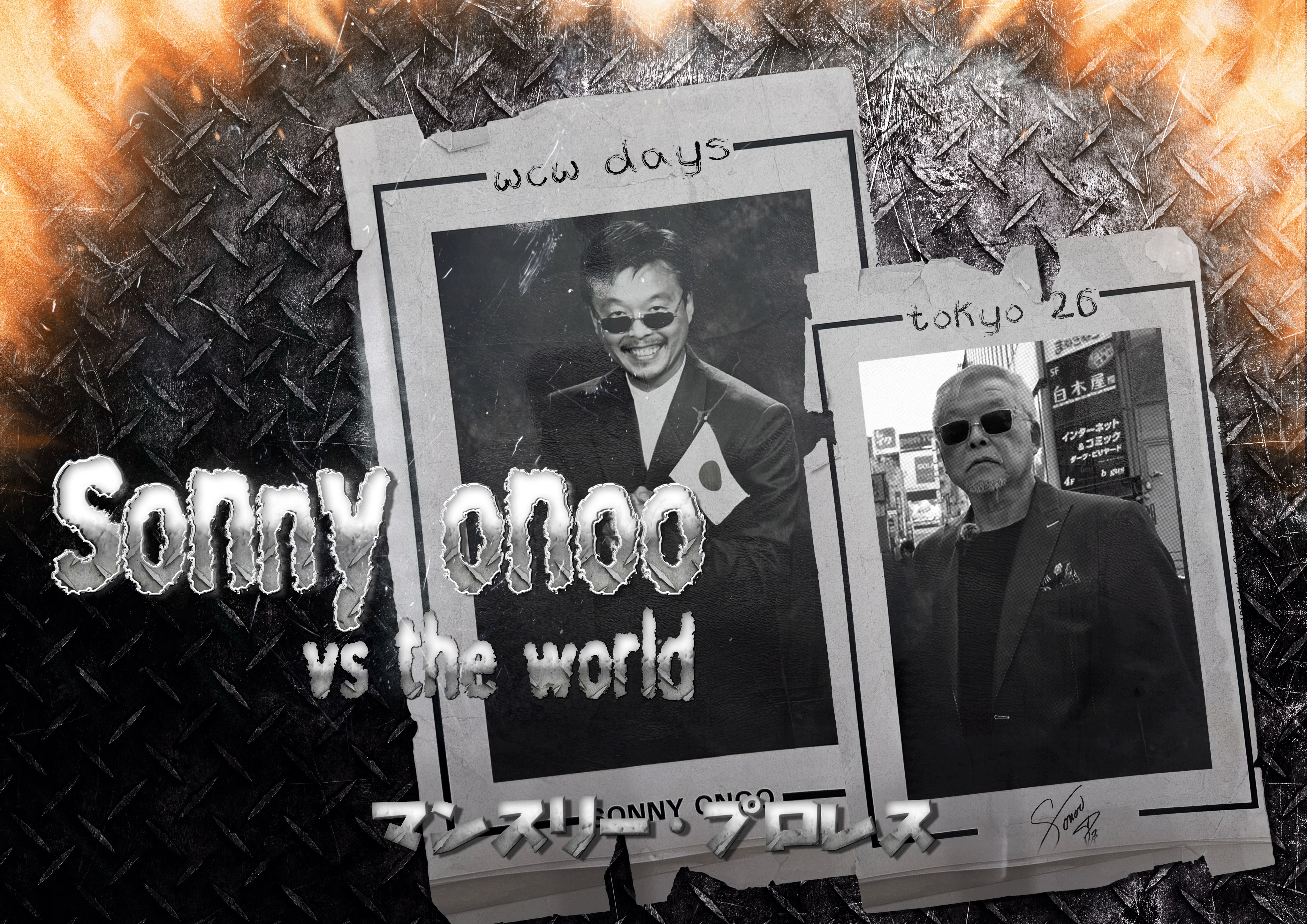
Vertical Bison | MP
By: Thom Fain
There is a shorthand in professional wrestling for someone who can read a room: they call it “having the territory.” Sonny Onoo has had it for more than thirty years.
The man WCW executive Eric Bischoff once described as indispensable — a cultural interpreter who could feel the tension in a negotiating room in Tokyo the way a referee feels a crowd turning — has spent three decades doing work that rarely makes the highlight reel but always shapes the result. He brokered the relationship between WCW and New Japan Pro-Wrestling at a time when it had all but collapsed. He put a mouthpiece and a manager’s jacket on some of the most technically gifted wrestlers in the world — Keiji Muto, Masahiro Chono, Ultimo Dragon — and made them legible to an American audience that didn’t yet know how much it needed them. He helped build the international framework for the nWo, one of the most lucrative angles in wrestling history, an angle that generated an estimated eight million dollars in t-shirt sales in Japan in a single year. Then, as quietly as he had arrived, the era ended. And like all the best operators in this business, Onoo simply moved on to the next thing.
The next thing, as it turns out, is now.
Japanese wrestling in 2026 is a different animal than the one Bischoff flew across the Pacific to save.
Streaming has democratized access to a degree unimaginable in the WCW era — fans in Cleveland and Copenhagen can watch NOAH’s Monday Magic series, with its anything-can-happen format and cross-promotional main events featuring talent from New Japan, DDT, and Dragongate, the same night it airs in Japan. NOAH’s Monday Magic was conceived as a weekly project designed to heat up the start of the week with unpredictability at its core — surprise appearances, unannounced matchups, a format built around the idea that the most exciting thing in wrestling is not knowing what you’re about to see. It has become one of the more adventurous concepts on the modern puroresu calendar, and a natural home for the kind of cross-pollination Onoo spent his career engineering from the outside.
Meanwhile, Marigold — the joshi puroresu promotion founded in April 2024 by former Stardom co-founder Rossy Ogawa following his departure from that company — has rapidly established itself as a new force in women’s wrestling, drawing in some of the most celebrated names in the joshi landscape and setting its sights explicitly on international expansion. Within the broader CyberFight ecosystem, alongside TJPW and NOAH, Marigold now has access to one of the most robust streaming and production infrastructures in Japanese wrestling — and to a talent pipeline that Onoo, in his role as U.S. agent and scout, is actively helping to build.
That’s the work he is doing now. Finding American and British independent wrestlers with something transferable — not just athletic ability, but adaptability, the willingness to be humbled by a different style in front of an audience that hasn’t decided yet whether to believe in them — and walking them into Japanese locker rooms the same way he once walked Bischoff into New Japan’s boardroom. Building relationships slowly and correctly. Knowing, as he has always known, that in Japan the key to doing business is not the contract but the trust that precedes it.
I talked with Sonny Onoo ahead of his latest visit to discuss the WCW era as it actually was, as well as what the new landscape of Japanese wrestling looks like to someone who helped lay its first international foundations.
And, to hear about why he believes the most exciting opportunities in the business are happening on the women’s side.
Monthly Puroresu:
Sonny Onoo, you’re here in Kabukicho, getting ready for NOAH Monday Magic. It’s Super Bowl Sunday back home. But we’ve got NOAH tonight. How are you feeling?
Sonny Onoo:
Very good. Look! Godzilla’s up there.
Monthly Puroresu:
Sure enough, we’ve got some Kaijus, some big Kaijus in Kabukicho. The home of monsters – monster wrestlers, monster managers. Legendary manager, Sonny Onoo. I know you’ve been working on doing some talent agency and bringing some brand new wrestlers to Japan. How’s, how’s that going? It’s the “Chosen One” Tryout program.
Sonny Onoo:
What we do is we kinda screen the talent for, I think, somebody who they’re looking for. They… You know, like NOAH and Monday Magic. Matter of fact, I had a meeting with Tokyo Joshi. We’re looking for some talent that can work here and learn here and make themself better. And, of course, more than anything else, if they can do it here, kinda like in New York, you can do it back home.
Monthly Puroresu:
I mean, it is the home of the best pro wrestling on the planet, wouldn’t you say? And you’ve been doing this for a long time, right? About 40 years.
Sonny Onoo:
Yeah. But if I was 40 years younger, I keep telling the ladies around here. But yeah, correct, about 40 year.
Monthly Puroresu:
Of course. And let me take me back to that time, the WCW – New Japan partnership, 1993. Relationships were a bit fractured at the time. Eric Bischoff brought you over here, and he said you could read the room better than him. [At one point] you can see NWO shirts all on these very streets. And he said you were better at reading the room than him. What was that like? You know, what are some of the cultural cues that Americans might miss, that are important to Japanese promotions and the wrestlers here in Japan?
Screengrab from WWE Network
Sonny Onoo:
Well, You know, we have some ugly Americans here. You know American have tendency to think that, that the United States is center of the universe, whether it’s wrestling or baseball. Look at baseball. Who is the center of the universe right now? As
Monthly Puroresu:
Yep. Shohhei Ohtani.
Sonny Onoo:
That’s right. So, you have to look at in a context of, you’re gonna get to get over worldwide. You know, that’s the most important part. And, and one of the things, if you’re gonna wrestle, you can’t just wrestle American style. Guys go out there and learn the Lucha style, guys go out there and have the strong style in Japan. I think that’s very important for you to become a complete wrestler.
Monthly Puroresu:
I agree. And, you know, from back in the ’90s to today, it’s very important for you to learn a variety of wrestling styles, right? I’ve talked to many pro wrestlers here in foreigners who come here, and that style is different here than in the US, than in Britain; and it kind of becoming part of a complete package, right?
Sonny Onoo:
Right. And you gotta be able to adapt, right? You go to Europe, you go to England you gotta be able to wrestle their style.
Monthly Puroresu:
Right.
Sonny Onoo:
And, and whether you go to Japan, you gotta wrestle their style. And you know what? Because of WWE and Netflix, wrestling is going worldwide. You know what I mean?
Monthly Puroresu:
HBO Max and AEW — and streaming right here [from Shinjuku FACE] on Wrestle Universe.
Sonny Onoo:
Yes. I mean, I get, I get call from people from promotions in India — China, Philippines along with, of course, all the European — you know. I just talked to, Mr. Takagi-san about maybe using some of the Tokyo Joshi talent to go to Israel.
Monthly Puroresu:
Yes. Sanshiro Takagi, of course, president of CyberFight and Wrestle Universe where we’ll be streaming live tonight. It’ll be Monday Magic. But I wanna talk more about, not just Takagi-san, but the other veterans in your orbit, in your friend circle, right? Masahiro Chono Keiji Muto, Ultimo Dragon, Kaz Hayashi.
Now, let’s take it to the American side. Can you tell me, in, in the 90s, were there any funny cultural moments where they needed your help in the American scene?
Sonny Onoo:
There’s a great story from about ’94, ’95, we came here on a tour and I was here. And we had Paul Wight, The Big Show. And he was a young man, you know, and his first time in Japan. And of course, I think it was a half rib — I think Ric Flair said to him, “Hey, you gotta go downstairs to the spa. They’ll scrub you clean. The ladies will come and scrub you clean.” You know, Paul gets a little excited and he says, “Oh, really?” So he goes down there and I thought there were gonna be some issues, maybe.
Monthly Puroresu:
Yeah. [laughs]
Sonny Onoo:
So I… You know how a Japanese onsen is like? It’s like a big, big tub, like a swimming pool. So I’m in the corner, you know, just kinda a towel on my head like they do here and just kinda being a fly on the wall. And sure enough, Paul Wight walks in. The Big Giant.
Monthly Puroresu:
All seven foot of him. [laughs]
Sonny Onoo:
Yeah. He walks in and his idea of what was gonna happen wasn’t like that all… You know, his expectation was a little different. So they had like maybe five or six little 4’5″ Japanese ladies that is in their 60s you know, all dressed in white with the white towels on their head and — you know, white long sleeves and long pants. They come out and they’re there to scrub him, right?
Monthly Puroresu:
Yeah. Wow [laughs]
Sonny Onoo:
And give him, wash his back and stuff. Of course, poor Paul not knowing how to speak the language, you know, he’s kinda, “Okay, you want sit down? All right, I’ll sit down then.” They scrub him, you know, scrub him between their fingers and they told him to stand up at one point. This is great. So he stands up and leans against the
Monthly Puroresu:
Oh, no.
Sonny Onoo:
…like he’s getting frisked. Right? So they started washing his leg and this one lady walks around front of him between him and a wall and she dunk herself on his, his …his junk.
Monthly Puroresu:
No…
Sonny Onoo:
And they all started to laugh. You know, just giggle. And I almost drowned in the pool I was laughing so hard. So, those moments —
Monthly Puroresu:
Priceless.
Sonny Onoo:
An innocent moment, but it’s priceless.
Monthly Puroresu:
And, you know, on the American side though, you brought Kaz Hayashi, Ultimo Dragon, that WCW-New Japan relationship. It was really a nice pipeline between the two promotions.
Sonny Onoo:
Oh, absolutely.
Monthly Puroresu:
What was it like for them over in America? Can you tell us any stories?
Sonny Onoo:
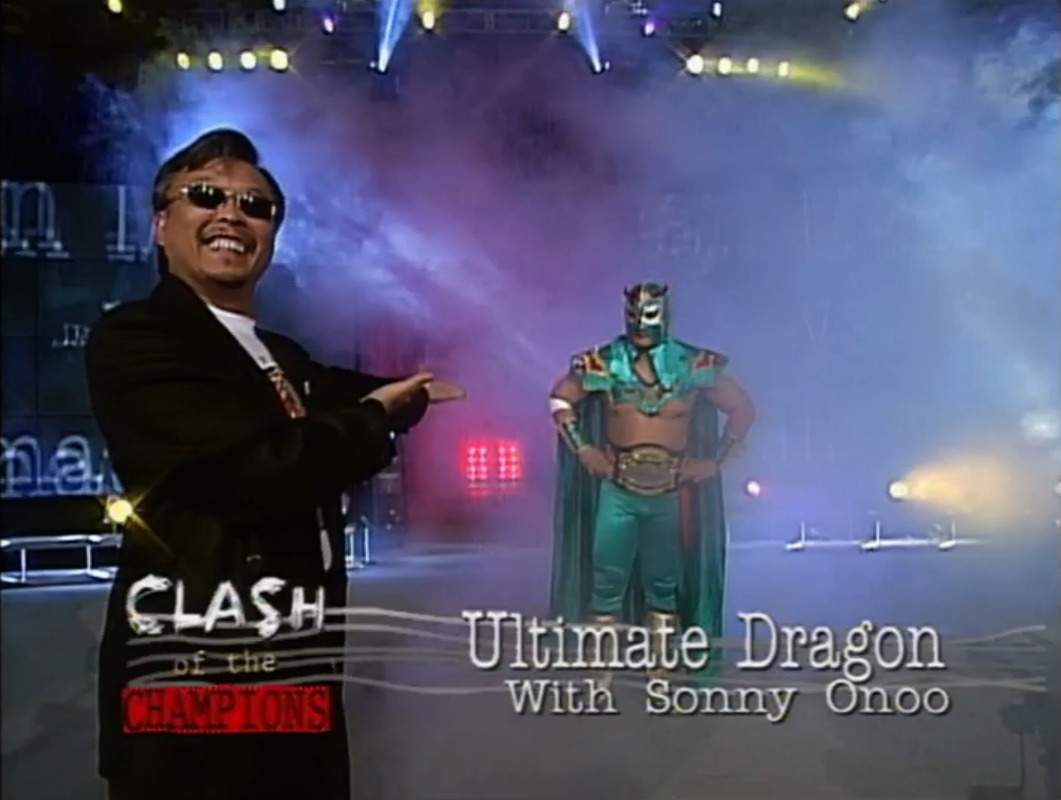
Yeah. I think for them having someone like me help them in front of the camera as a manager, you know, he’ll … We’re a natural heels ’cause we’re from another country. And, and I you know, Ultimo Dragon was essentially a big babyface. But with me [being heel] of course storyline wise, we did the split. Because, I was doing all the evil things and he didn’t like it. And, and even young Kaz Hayashi was here [in WCW], I kinda did the same routine [as heel] and [we did it again] with Ernest Miller, with Perry Saturn on pay-per-view. So, I think because of my ability to [bridge cultures for the Japanese] ’cause it is episodic TV.
Monthly Puroresu:
Right. American television, you have to part can, you have to kind of play to the camera. It’s totally different style than here in Japan, where it’s pedal to the metal.
Sonny Onoo:
In Japan it’s like, “You fight me. Let’s find out who’s got what.” You know, over there [in America], it’s more, a lot more story oriented. And so, you gotta be able to, to speak and relate, and nobody wants to listen to broken English.
Monthly Puroresu:
Especially in the ’90s.
Sonny Onoo:
Right, of course. So, you know I think that’s what worked and, and it was helpful for when we did the relationship with New Japan, Jushin Thunder Liger, Great Muta, Tanimoto, Otani.
Region Break: From Managers to Translators, Bringing Puro to the West
Monthly Puroresu:
Were there any funny stories about them in America that you can remember?
Sonny Onoo:
Well, couple points. You know Muta-san had I think it was one of the pay-per-view that Great Muta was here. And his wife Sai-san, which a dear friend of mine, and she was jet lagged. You know, she brought her little baby, but the same age as my youngest. And she just could not function that day… And my wife ended up taking the two babies, two boys, and, and, and essentially spent about 24 hours with them.
Monthly Puroresu:
Yeah.
Sonny Onoo:
You know? And of course, how do you feed the baby? Because it’s not yours. So that was, that was kind of [a real life] thing, but we did get to feed him and we figured out a formula and went we went out got a formula and, were able to feed Great Muta’s babies. So, you know, [again] it’s all about relationships. And one the things that people don’t realize, it’s our relationship [that makes it] happen here.
Sonny Onoo:
People think they can come here and just do —
Monthly Puroresu:
Do whatever they wanna do.
Sonny Onoo:
And Thom, you know, you’ve been here over two years, yeah? You can’t just come here and just think this, say, “Hey, I got this. I got my credentials.”
Monthly Puroresu:
Nope.
Sonny Onoo:
[Then it’s like] “Why am I not working?” Over here, it’s a relationship building. And, I’m lucky now to have many of them, in nearly 40 years of this business. Matter of fact, I’ve only been here for 10 days, and tomorrow I’ll be going back. But I met with Antonio Inoki’s former manager. He reached out to me. We went out to dinner. I was with Chono-san for lunch today. Muta-san took us to a dinner, and Nosawa-san. So, you know, those things [matter over time]. And they had a show here I was at, Sendai Girls.
Monthly Puroresu:
Yep. Satomura-san. You’ve known her since she was a teenager back in WCW.
Sonny Onoo:
Yeah. So I was here with Satomura-san. You know, I remember when 16 years old. Now she’s got her own promotion. She’s doing a great job. So, you know, I have to think about the relationship.
Monthly Puroresu:
And those relationships are so important. So from the ’90s to today, you’ve cultivated those relationships. You’ve maintained them, and they remain. People remember you.
Monthly Puroresu:
Talk about relationships now in the modern era of pro wrestling. Tony Khan has relationships with many of the major promotions here. And AEW — some of the Japanese fans see it as being a one-way street, right? New Japan’s maybe not getting as much in return as AEW. What was different about that WCW/NJPW relationship versus the All Elite/NewJapan relationship?
Sonny Onoo:
Yeah, from day one, my instruction from Eric Bischoff was treat [New Japan] like they treat us, which is not a hard concept. And in Japan, and certainly your Japanese fans will understand, being mindful[pof others is taught from child on. If I’m loud, how does it affect the people around me? For instance, before during coronavirus, people were masked here [in Shinjuku] not because they were afraid of catching something, but they were afraid of giving something to someone else.
Sonny Onoo:
And you know, that’s the difference, right? That is the ultimate difference, even in business. And I have said, you know, they’ll come in and entertain you. You can come here, and your product could be better. You can provide better service. Less expensive, but I can’t get through the door [in the Japan market] — but they’ll entertain you. They’ll take you out drinking every time you come, and give you a great time.
Sonny Onoo:
But I told one executive, “Hey, you’re not gonna get it done here.” And he says, “Why?” And I said, “Because likely, the business that you trying to get into, they already have the business.” You know? So that’s the difference.
Monthly Puroresu:
The English broadcast teams here in Tokyo have done great work to help export the [Puroresu] culture back to the West. How does it compare with what you were trying to do in WCW’s era? What’s better now and what worked back then?
Sonny Onoo:
Well, I think, you know, we didn’t have all that internet stuff that we had, we have now.
Monthly Puroresu:
Live streaming.
Sonny Onoo:
Yeah.
Monthly Puroresu:
You can watch anytime, any place.
Sonny Onoo:
So I think that, that’s the key difference. I think … And I think product, you know, back in the days when, when American hardcore fan of Japanese wrestling was buying those videotape, trading them and stuff, you know?
Monthly Puroresu:
On forums, and —
Sonny Onoo:
Right. Now you can just watch on the phone. You can watch it instantly, right? Or live. Tonight’s show is live.
Monthly Puroresu:
Tonight’s show is live and it’s NOAH, and we’ve got Marigold’s talent [being featured]. So tell us about that liaison work that you’re doing between the US Independent Circuit and CyberFight. What excites you about what Rossy Ogawa is building and how does women’s wrestling business in Japan differ from working with the men?
Sonny Onoo:
Honestly, I think women wrestling been on the way up for our last few years, and I think it’s got amazing amount of still upside potential. And where did Joshi come from? You know, this is right here. Be it Tokyo Joshi or Marigold or, or whoever. And the unfortunate thing, I think [as a promoter] you shouldn’t limit your talents to one company. I know STARDOM is connected to AEW and that’s what it is. I think we would be so better [as a culture] if they could maybe work with a different company. And that’s what I’m gonna [focus on]. I had a meeting with Ogawa-san yesterday and I wanna be taking some of their talent to Israel.
Monthly Puroresu:
That’d be great. It’s the global honored crown. We’ve got a world title, it needs to go around the world.
Sonny Onoo:
World title means world title, not Japan and US, so.
Monthly Puroresu:
Yeah. That’s awesome. I look forward to seeing some of the amazing women’s athletes here wrestle more [abroad], get more opportunities, right?
Sonny Onoo:
Absolutely.
Monthly Puroresu:
It’s all about opportunity.
Sonny Onoo:
Right. And you know, I mean, going out internationally, that means increasing your fan base [as a wrestler], and an opportunity to earn money outside the country. I think it’s a great win-win deal.
Monthly Puroresu:
And you’ve said to me before, Japanese talent sometimes have trouble speaking up for themselves backstage. You know, about doing what’s best for them — so a manager can really help with that.
Sonny Onoo:
Well, I think it’s, it’s a very important. You know, I get it, doing the doing the international negotiation. You know the Japanese hate to say ‘No’. They don’t like conflict.
Monthly Puroresu:
Right. Honne and tatemae, right?
Sonny Onoo:
Right.
Monthly Puroresu:
They might say one thing, their expressions tell you something, but…
Sonny Onoo:
And, you gotta read that. You gotta be able to read it. And, and most Americans can’t. [Problems arise] like “Why aren’t we getting our paperwork,” you know? So those are the things, that I’ve been able to help with, even back then [in WCW]. And [the importance of] relationships – that’s what it is. Back in WCW and New Japan days when I was there, nobody even discussed how our talent was gonna be used. We didn’t have to worry about it when when Sting and Flair and those guys went over there, they were just perfectly fine because Masa [Saito] knew. Masa was trained in the US so he knew how to take care of those boys.
Monthly Puroresu:
Right, Minnesota.
Sonny Onoo:
Make sure we weren’t going to offend them and, and vice versa. So you know, that’s the kind of thing, that when Japanese talent comes [to America], same thing, you know?
Monthly Puroresu:
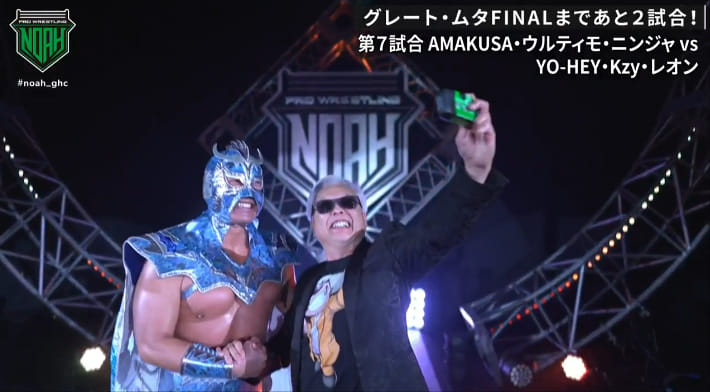
Well big picture, right? Let’s wrap this up with the big picture. You’re a big picture thinker. I know that after about five years of friendship and you’ve been doing this for so long going back to WCW, and you got to [manage at] Great Muta’s retirement show.
Screengrab from Wrestle Universe
Monthly Puroresu:
Sting and Darby and, you know, that had to feel like coming full circle. What was going through your mind at Yokohama Arena and what goes through your mind, the memories that you can tell us?
Sonny Onoo:
Well, what was, what was amazing for me is this, that negotiation. Because [there was] WWE and Nakamura-san, who wanted to wrestle Great Muta at the Tokyo Dome. So that was months before ’cause our show was —
Monthly Puroresu:
January 2023.
Sonny Onoo:
So we had to make sure that Mr. Tony Khan was gonna be not offended, you know. And that whole negotiation took like seven months. But we got it done and that’s the best of it.
Monthly Puroresu:
It was a great moment for the fans you know, worldwide and for Yokohama Arena. They blew up.
Sonny Onoo:
Yeah. One of the, one of the funny moment was, for me, the recognization of Takeda-san, head of NOAH.
Monthly Puroresu:
President of NOAH.
Sonny Onoo:
He asked me, “Sonny, do you want to go upstairs and do some autograph signing?” I did not come prepared for this. I figured there were other people signing, like their talent was signing upstairs and Yokohama Arena is a huge arena. So I go up there and — Thom, you were there. I go up the stairs and there’s like line of people. I’m thinking, “The hell?” So I said, “Who else is signing here?” Because you know, I didn’t think people knew who I was. Yeah, it been a while… and I wasn’t really a big picture guy selling in Japan.
Monthly Puroresu:
Well, the fans remembered you, right?
Sonny Onoo:
Exactly.
Monthly Puroresu:
It’s all about the memories you created to the fans, and the memories that this culture can create. And for those who haven’t come to Tokyo, what can you tell the fans at home about coming here and experiencing it live?
Sonny Onoo:
I’m telling you, do your homework. Don’t be that American, the “Ugly American”. Understand the culture, respect the culture, and you’ll have a great time. These are the most friendliest, nicest people in the world.
Monthly Puroresu:
Amazing. Well, as the inventor of the selfie, so I gotta ask.
Sonny Onoo:
All right. All right. Here we go.
Monthly Puroresu: Can we get one here?
Sonny Onoo:
Absolutely. Here we go. All right, brother.
Monthly Puroresu:
Thanks so much, Sonny Onoo.
Date:
February 16, 2026