

The Territory That Didn’t Exist: SEA Wrestling Has Arrived
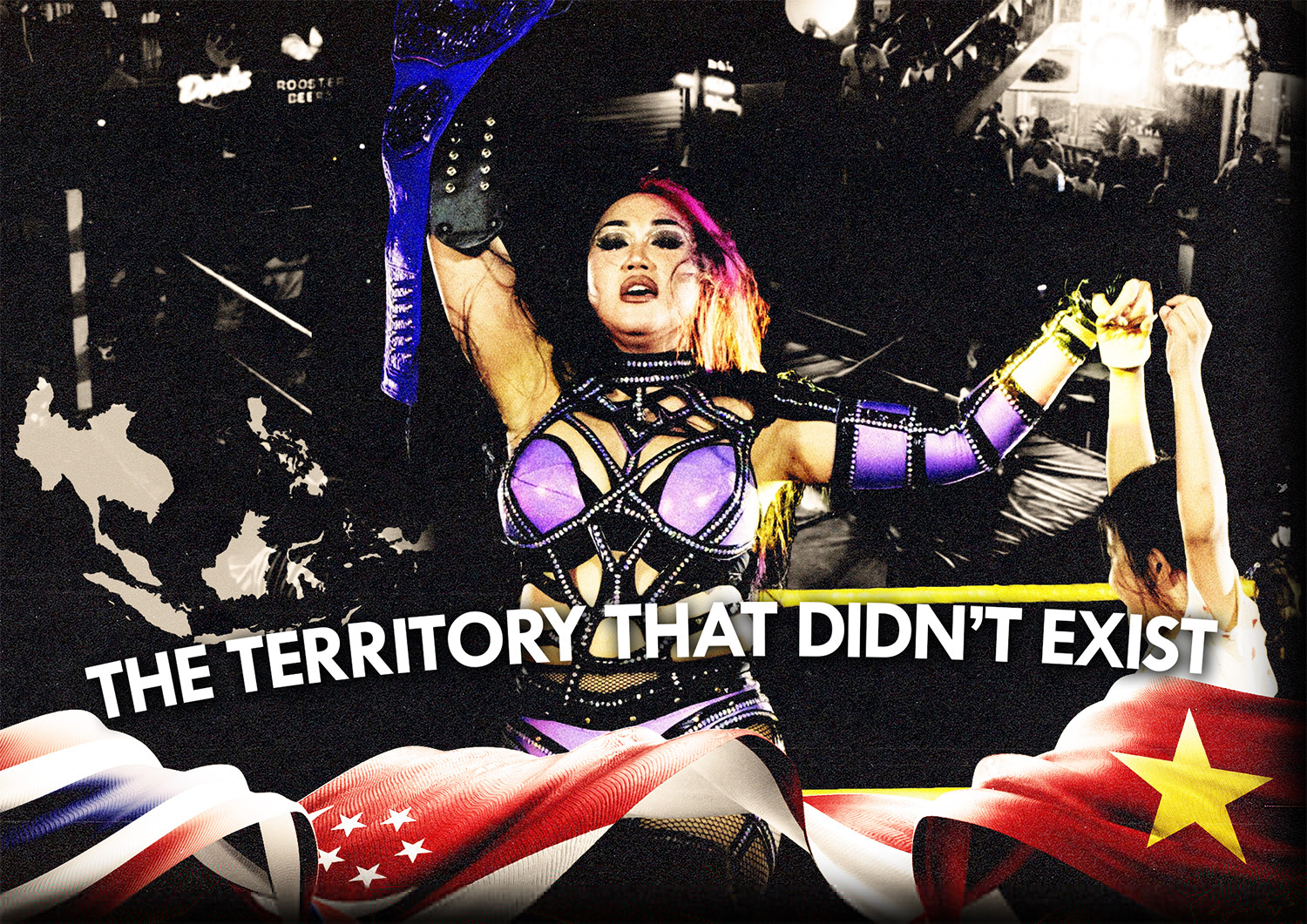
Peatzilla | MP
The Territory That Didn’t Exist: SEA Wrestling Has Arrived
By: Thom Fain
Art by: Srettapong Srimekarat, aka Peatzilla
How Japanese puroresu inspired a wrestling world across Southeast Asia that didn’t exist a decade ago — and how, last November, that world sold out a building in Tokyo.
Last November 14th, a wrestling promotion from Bangkok sold out a venue in Tokyo. Mind you, this wasn’t a novelty booking or a comedy side show. Fans were treated to a spectacle by a Thai company running its own event on Japanese soil (and under a revived Japanese brand), in front of a Japanese crowd. SETUP Thailand had paid for ad space around Tokyo to promote the thing. Somewhere in the building that night, HARASHIMA — a fixture of the Tokyo independent scene for two decades — shared a poster with Thai wrestlers making their first appearance. It was a special moment.
After all, Japan is the country that inspired Thai promoter Pumi Boonyatud, who has been building in a country that didn’t have much of a wrestling scene.
“With that show, I wanted to showcase Thai wrestling,” Pumi says, “but I also had one very specific goal: sell the venue out, and become the first [SEA] promoter to do it.”
They did. Restaurants near Tokiwadai Station reportedly filled up because of the crowd it pulled in. The show was called A New Dawn, and the title undersold the significance. Thailand is, after all, a country that had no wrestling tradition fifteen years ago. Here they were exporting a sold-out show, right back to the country that inspired it in the first place. It’s part of a larger phenomenon that’s been building for two decades in gyms, dance studios, and living rooms across Vietnam, Thailand, and Singapore.
To understand why the rise of Southeast Asian (SEA) wrestling, you have to go back to when there was nothing there at all.
Before There Was Anything
The true starting point, as far as SEA Wrestling Magazine‘s own archives can document it, is February 1984, when New Japan Pro Wrestling brought a card to the Araneta Coliseum in Manila. Antonio Inoki beat Bad News Allen in the first night’s main event. The following night in Quezon City, Inoki and Akira Maeda beat Riki Choshu and Animal Hamaguchi, with Tatsumi Fujinami and Black Tiger also on the tour. NJPW returned at the end of the year with a card that reads even better with three decades of hindsight — Keiji Muto, Shinya Hashimoto, Adrian Adonis, and Andre the Giant — and drew crowds the magazine’s own reporting puts as high as 15,000.
Then, mostly, nothing.
A local program called Pinoy Wrestling ran on Philippine television for roughly a year starting in 1989, blending American showmanship, European tent-show theater, and Japanese puroresu. The end product was something its own producers probably couldn’t have fully described, and it folded in 1990. The rest of the region didn’t get even that much. There was no territory system, no dojo, no promoter with a rolodex. For most of Southeast Asia, professional wrestling existed only as something that happened on television, made somewhere else, by people who would never come.
“I’m not sure the scene there has ever been lucky enough to have a straight line drawn on its journey,” says Simon Worden, editor of SEA Wrestling Magazine. “Different stakeholders have come on board at different times and helped build it back to what it is now. It’s hugely admirable to see the modern evolution of DEXCON and FPW as [examples of] the leading two brands, able to draw eyes from around the world and really be a place where world class talent wants to go and wrestle some of the very best in the region.”
Less Than Zero
Ask the people who eventually filled that vacuum, and they describe the same starting line, decades apart, in three different countries.
In Bangkok, Pumi Boonyatud had been a wrestling fan since he was three years old, obsessed with the characters and the stories, and stuck on one question that never left him: why had he never seen a Thai wrestler? He worked toward an answer sideways, reading wrestling biographies and eventually landing a job as a Thai commentator for Japanese promotions airing on local television. That job is how, around nineteen, he met Emi Sakura, freshly out of Ice Ribbon. Pumi’s own taste ran toward the King’s Road style of All Japan — Mitsuharu Misawa, Toshiaki Kawada, Kenta Kobashi, Akira Taue on the men’s side; Chaparita Asari, the Crush Gals, and Dump Matsumoto, still to this day one of the most famous professional wrestlers in Thai history, on the women’s. Sakura saw the same gap in the market that Pumi did, and the two decided to try to fill it.
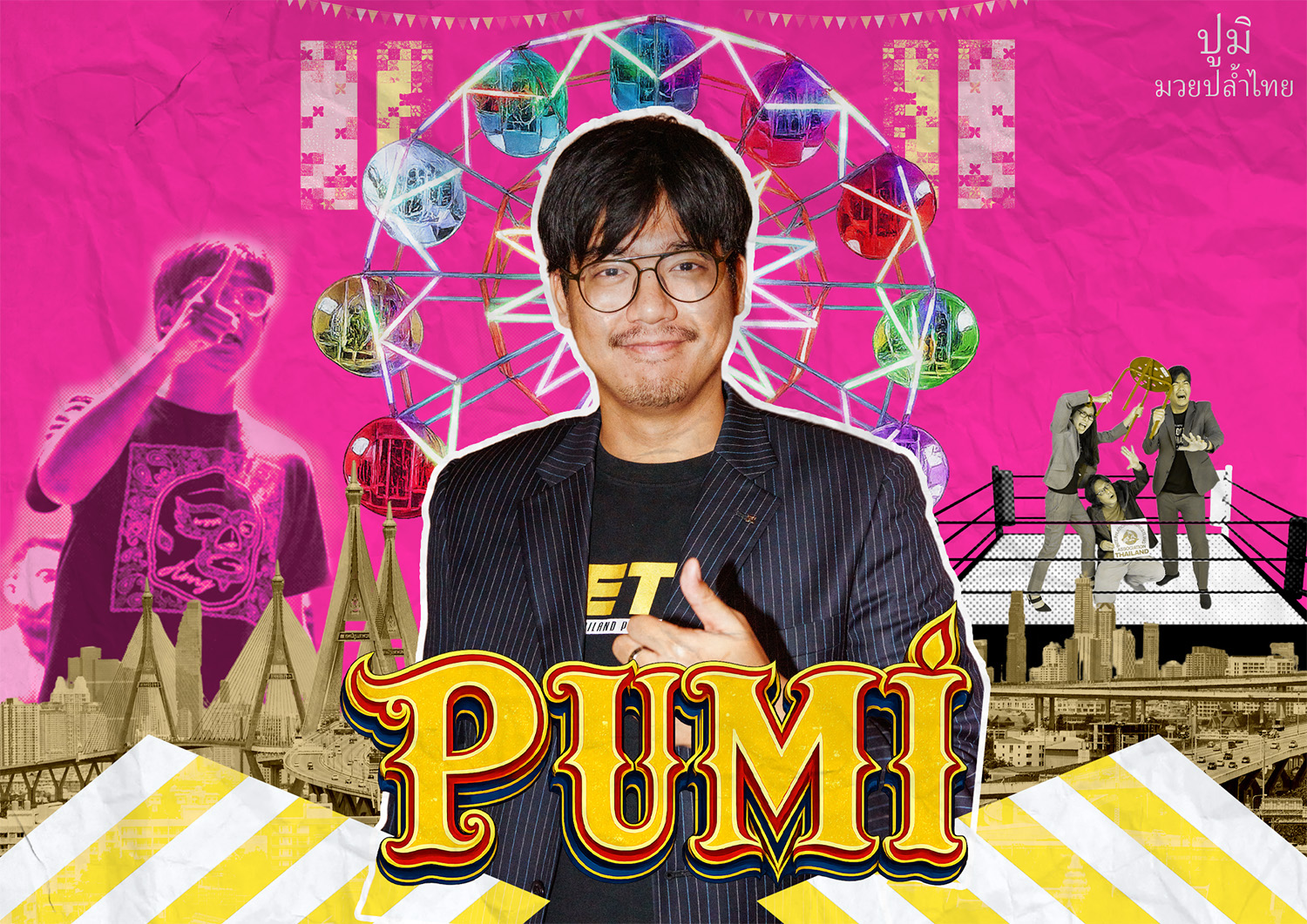
Pumi Boonyatud is the founder and promoter of SETUP Thailand, which he built from scratch with Emi Sakura after starting out as a teenage commentator for Japanese wrestling broadcasts on Thai television. He also produces IWA Thailand and, this past November, sold out SETUP’s first show in Japan, A New Dawn, in Tokyo.
“I think I started from less than zero,” Pumi says of what followed.
There was no framework in Thailand for licensing a “fighting sport,” no shared vocabulary for what they were trying to build. Some early trainees quit almost immediately, having assumed “scripted” meant “easy” — they showed up wanting to throw big flying moves on day one, and left when Pumi and Sakura started them on fundamentals instead. It took years just to build a roster deep enough to put on a show.
Sixteen hundred miles west, in Ho Chi Minh City, a handful of young Vietnamese wrestling fans were solving the identical problem with even less to work with. “Vietnam had no wrestling schools, no wrestling coaches, and no rings,” says Carey Wass, VPW’s current promoter, recounting a founding story that predates his own involvement by six years. Rocky Huynh, Sid Nguyen, and An D found one another through Facebook groups around 2015, united mostly by the fact that WWE had somehow made it onto Thai satellite broadcasts they could pick up at home. “The roster essentially taught themselves through YouTube videos, experimentation, and training together in public parks, rundown gyms, and dance studios,” Wass says. They called themselves the Saigon Pro Wrestling Club. For years, they ran shows on judo mats in front of crowds made up mostly of friends, because they didn’t have a ring and couldn’t afford one.
Singapore’s version is shaped slightly differently but built from the same material.
“Singapore actually had a wrestling scene many years ago,” says Andruew Tang, who co-founded SPW with a partner named Vadim in 2011, “but by the time we started, there wasn’t an active wrestling school or anyone developing the next generation. Those connections had largely disappeared.” Whatever had existed before left no thread he could pick back up. He and Vadim started, in practice, from the same nothing everyone else did.
“I think I started from less than zero.” — Pumi Boonyatud
“Pumi took the idea from Japan, and specially Ice Ribbon, running mat shows,” says Worden. “Eliminating the ring costs was a sensible and enterprising move, very typical of the cultures in this part of the world. Test the waters, build slowly, then get the ring.” But, it’s also an aesthetic choice that not every SEA promoter wanted to follow. “Plenty of others started off using available boxing rings,” says Worden, “like PWR and MYPW, and this also likely helped keep costs low. The issue with that is that dangerously hard rings are not exactly suited to less experienced wrestlers, for fear of injury, and you’re rather limited in where you can run shows… While [mat shows] was a Japanese thing, it feels far more like something that could become a hallmark of Southeast Asia in years to come.”
The Ones Who Showed Up
One thing all these stories have in common is who showed up to help. It’s too easy to cite “Japanese influence” and assume that YouTube simply inspired young people to crash around and start a wrestling school. There are specific people lending their effort and generosity, because they saw something in these emerging markets before anyone else.
For Pumi, it was Emi Sakura, who didn’t just lend her name to the project but moved her Gatoh Move brand into Thailand and helped train the first generation of Thai wrestlers herself, alongside Masahiro Takanashi, Shinno Hagane, and Kaori Yoneyama. For VPW, it was Fugo Fugo Yumeji, a Japanese wrestler who traveled to Vietnam in the club’s earliest days and gave the self-taught roster its first real technical correction from someone with legitimate professional experience. Fugo Fugo Yumeji also founded World Underground Wrestling, whose Philippine offshoot now runs shows out of a converted arena in Quezon City called the Brawlpit. The same wrestler sharpened up Vietnam’s first roster and put his name on a brand now running underground in Manila — one man, two blank slates, a decade apart.
For Andruew Tang, it was a rotating cast that amounts to a tour of puroresu’s different schools — New Japan, Dragon Gate, Gatoh Move, GLEAT, Michinoku Pro — and, in 2023, direct training under Tajiri, one of the style’s most respected technicians.
So the wrestling did not arrive as tape for would-be wrestlers to study alone in a bedroom; rather, puorresu came to Southeast Asia through people with a lineage who took time to correct grips, explain why a bump has to mean something, and why heat matters as much as it does.
Pumi later spent time inspecting New Japan’s dojo directly and what stuck with him most was the culture, as he recalls. “At the NJPW dojo, trainees start by helping and supporting others before being promoted,” he says.
He adapted the model instead of importing it wholesale, softening the hierarchy, because in Japan wrestling is a job people commit their lives to, and in Thailand at the time, it was closer to a hobby people could still be talked out of. “When it is time to study, we are serious,” he says. “When it is free time, we try to make trainees feel comfortable and treated like friends.” Strict enough to build real wrestlers, loose enough that they’d stick around long enough to become them.
Andruew’s version of the same lesson is more compact. “One of the biggest things I learned in Japan is that less is often more,” he says. “A great wrestler doesn’t need an endless list of moves to win over a crowd. Every action should have purpose.” More than a moves, Andruew understands the need for a pro-wrestling philosophy. It’s the thing he says he’s spent his career trying to teach, more than any specific hold.
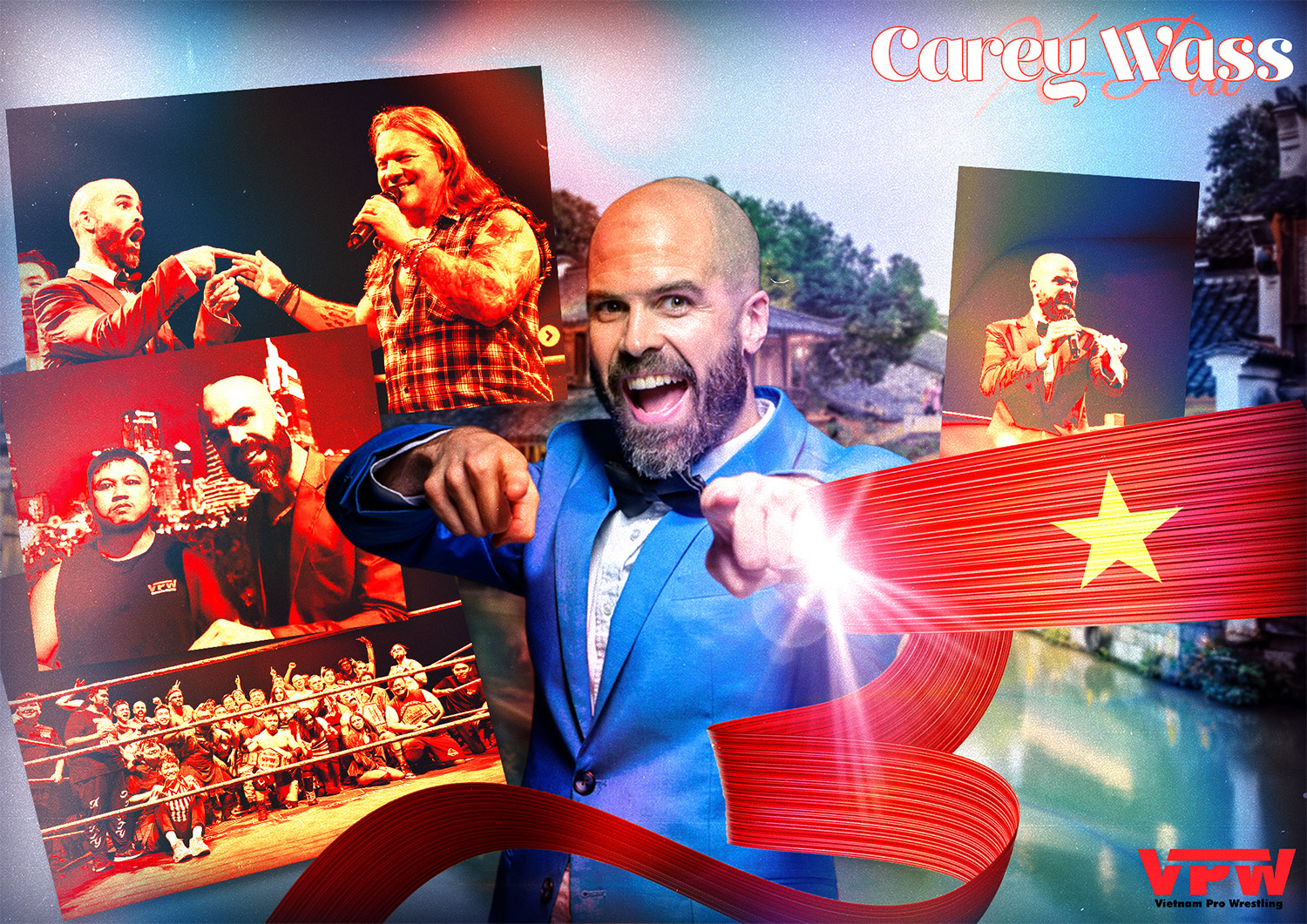
Carey Wass is the promoter of Vietnam Pro Wrestling, who joined the company in 2021 as a ring announcer — performing as “The X-Pat” — before taking on the job of growing it. Under his lead, VPW has run its biggest show to date in Saigon Slam Jam, hosted a visit from NJPW chairman Sugabayashi, and become the subject of Chris Jericho’s documentary Vietslam: The Story of VPW
What They Kept, What They Left
Every promoter in this told Monthly Puroresu they had the same instinct at some point. First take the foundation, then deliberately build something that doesn’t look like the source. And that’s exactly what happened in Thailand, it’s the reason SETUP exists as a company separate from Gatoh Move Thailand at all.
Gatoh Move in Japan is a Joshi-oriented promotion with a family-friendly image to protect. Its Thai audience wanted something else — more drama, bigger characters, closer to American sports entertainment than to the restrained, believability-first style of its Japanese parent. Rather than force the mismatch, Pumi and his partner Paksa split off and built something new “while still supporting each other,” he says. SETUP kept the training lineage and the trust built with Japanese partners. It left the presentation behind.
Wass describes the same instinct at VPW, just with more ingredients in the mix. “Japanese wrestling has absolutely influenced us, especially in terms of in-ring philosophy,” he says, and he doesn’t hedge much when he adds that “the highest level of in-ring wrestling in the world still comes from Japan.” But VPW’s roster is just as shaped by American wrestling, lucha libre, and DDT’s stranger, more experimental corner of the Japanese scene.
Wass’s own character, “The X-Pat,” started as a straight-laced ring announcer before he decided the room needed more energy than a tuxedo could provide, and swapped it for a bright blue suit, shorts, and a circus-ringleader delivery designed to rile up the local audience.
Andruew Tang states the underlying principle most plainly of the three. “I don’t believe in copying another promotion’s style wholesale,” he says. “What works in Japan is shaped by its own culture and audience.” His job, as he frames it, is to produce Singaporean wrestlers unique unto themselves. But also, he says, to take “the discipline, work ethic, and storytelling” of Japan and let the result sound like Singapore — a high-wire, multicultural vibe at a promotion where Japanese, American, and British influences are all running through the locker room at once.
“The key,” he says, “is making sure those influences don’t become imitation.”
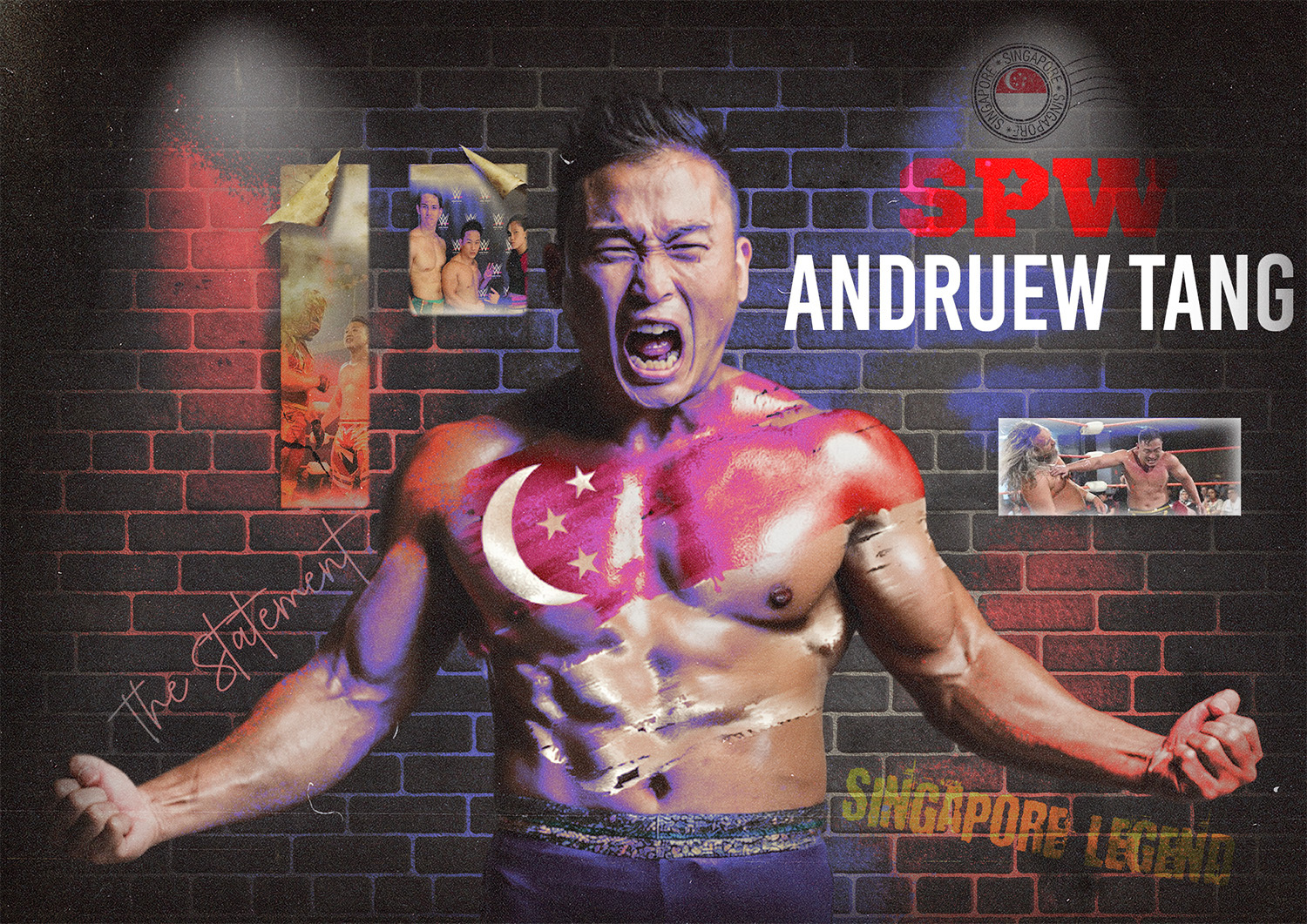
Andruew Tang co-founded Singapore Pro Wrestling in 2011 and, in 2015, became the first Singaporean wrestler to compete for New Japan Pro Wrestling. As SPW’s founder, head coach, and top star — wrestling as “The Statement” — he’s trained talent including Dante Chen, who went on to a run in WWE, while building a roster that’s hosted Kenny Omega, Emi Sakura, Riho, and Meiko Satomura
Proof of Concept
Singapore offers the clearest paper trail. Since 2011, SPW’s alumni list has quietly become one of the more remarkable in the region — Kalisto and Tajiri as former WWE United States Champions, Johnny Gargano as a former NXT Champion, joshi royalty in Emi Sakura, Riho, and Meiko Satomura, UK stars Pete Dunne and El Lindaman, and, most notably, current AEW executive vice president Kenny Omega. In 2015, Andruew became the first Singaporean to wrestle for New Japan, on the undercard of the promotion’s lighthearted Chara Expo show, against Michael Nakazawa. Although that seems like a comedy match, there’s nothing funny about what he remembers backstage — reactions and encouragement from Shinsuke Nakamura and Kazuchika Okada, two of the biggest stars in the company’s modern history. “Walking down that entrance ramp wasn’t just a personal achievement,” he says. “It felt like a statement. Singapore wrestling had arrived.”
“It felt like a statement. Singapore wrestling had arrived.” — Andruew Tang
“SPW from around 2015 to 2020 was really ahead of the pack in terms of the volume of top tier puroresu talent it brought over, says Worden. “Of course that talent turned heads and put SPW on the map, but I think the bigger impact was the motivation and experience it gave the wrestlers… I don’t think I can express how much others like Masahiro Takanashi and Emi Sakura have given back to the roster; a lot of it is behind the scenes, things we’ll never see. Whether it was coming over to give someone like Alexis Lee a female opponent to learn from, or working with those on the sidelines as trainees.”
The system kept generating evidence after that.
WWE’s Canyon Ceman scouted an SPW show in Changi in 2017; two years later, Andruew, Alexis Lee, and a trainee named Kaiser Trexxus represented Singapore at WWE tryouts in Shanghai. Kaiser Trexxus became Dante Chen, and spent several years in WWE’s system before that run recently wound down. Andruew, who coached him “from the very beginning,” doesn’t hide how personally he takes the outcome.
“His success proves that our system works,” he says. “It shows that a wrestler can start training in Singapore and reach the highest level of the industry through hard work and the right guidance.” He’s hoping Chen comes home to SPW now that his WWE chapter is finished.
VPW’s version of outside validation arrived from a stranger direction. In 2023, Wass and Rocky Huynh told VPW’s story on Talk Is Jericho, and Chris Jericho liked what he heard enough to start developing a documentary about the promotion — Vietslam: The Story of VPW — eventually bringing in filmmakers Nathan Mowery and Robert Peak to shoot in Vietnam. Wass is careful about what he wants people to take from it — at heart, it’s a story about a roster that started with nothing and refused to fold, made at a moment when Vietnam itself is full of young people trying to build new industries and new identities.
“I want people to watch the film and feel inspired,” Wass says, “not just by wrestling, but by the idea that extraordinary things can emerge from unlikely places when people refuse to give up.”
Jericho recently told FOX News about everything he witnessed in Vietnam, and what he wants people to take away from the documentary. “It’s really about the human desire to do great things and the fire that we all have inside to make something happen and going up going up against the government,” says Jericho. “I mean, this is not the United States where you and I can just, hey, let’s put on a show tomorrow night. We rent an arena, we do it. It’s not like that there, It’s a very strict socialist almost communist government in a lot of ways and you’re not allowed to just do whatever you want.”
Indeed, there is a long way to go for these promotions to rival the quality of American wrestling or Japanese puroresu — but the stuff that really makes a wrestler, is the stuff Jericho found in spades during his visit to Vietnam.
“I mean, these are just normal people going up against the government of Vietnam to get a permit to put on a wrestling show,” Jericho told FOX. “That’s pretty intricate, deep stuff that took a lot of time to make happen. So, all of these things was one of the reasons or all contributed to the reasons why I wanted to do this documentary because I just felt it was a great story to tell on so many different aspects.”
The Ledger Flips
For most of this story’s history, the traffic ran one direction — talent and knowledge moved from Japan into Southeast Asia, never the reverse. That’s no longer accurate, and the shift happened fast enough that most of the evidence is only a year or two old.
Malaysia’s Miles Karu left for a DDT excursion, the kind of opportunity that would have been unthinkable a decade ago for a wrestler from a country with no developed scene of its own. SETUP’s Matcha has wrestled for TJPW, including a match at Ryogoku Kokugikan, one of the more storied buildings in Japanese sports. Ice Ribbon’s Yappy has refereed in Manila. Zack Sabre Jr. and El Phantasmo have both worked Bangkok cards. NJPW’s chairman, Sugabayashi, sat down with Wass at Wrestle Kingdom to talk about Vietnam, then flew to Ho Chi Minh City in March to watch VPW’s Spring Bash in person — a level of institutional attention that didn’t exist when the promotion was still teaching itself moves off YouTube in a public park.
“Long term, I would love to see a co-promoted event between NJPW and VPW in Vietnam,” Wass says, careful not to overstate where those conversations currently stand. But the fact that the conversation is happening at all — chairman to promoter, in person, in Vietnam — is itself the story. Japan isn’t just exporting technique into the region anymore. It’s showing up to see what’s been built with it.
A New Dawn
Which brings the story back to Tokyo, and the stakes actually riding on that November show SETUP produced.
Pumi’s relationship with Japan runs through one specific person: Tatsukuni Kinroku Asano, founder of IWA Japan, known to the Thai roster simply as President Asano. Pumi met him years earlier through an unrelated job and eventually talked him into letting an old IWA character, the Kappa, headline a new storyline in Thailand. It worked well enough that Pumi ended up as IWA Japan’s new producer, folding its history and title lineage into what became IWA Thailand — an act of preservation, not just licensing. “We preserved the lineage of IWA Japan titles,” he says, “keeping the nostalgia alive.”
Once that relationship existed, the Tokyo show stopped being purely a business goal and became something closer to a debt Pumi wanted to pay off in public. Masa Takanashi — one of the trainers who’d helped build Thai wrestling from its earliest days alongside Emi Sakura — had been injured. “One major motivation was to honor Masa Takanashi,” Pumi says. “We wanted to show him that what he helped start had grown into something meaningful.”
So they sold the room. Unlike in Thailand, where the SETUP story was already common knowledge, most of the Tokyo crowd would be meeting these wrestlers for the first time — which meant bilingual promotion, heavy branding, and one clear objective. “In Japan, everything is new,” Pumi says. “Our goal was simple: sell out the show.” Trust, he says, was the whole game. It didn’t come off without a hitch — Pumi still laughs about an earlier TJPW crossover show where someone unplugged the arena’s only music cable mid-entrance to charge a phone, killing Yuki Kamifuku’s music stone dead. Kamifuku, a professional, worked through it. Tokyo went smoother. HARASHIMA ended up on the same poster as Thai talent making its Japanese debut, a pairing Pumi still calls surreal. The ads went up on Tokyo Tower. The building sold out.
The remarkable sequence is a Thai promoter, trained by a Japanese wrestler, running a revived Japanese brand… to honor an injured Japanese mentor, in front of a sold-out Japanese crowd he’d never had access to before any of this started.
Puroresu essentially got exported to Thailand, then got sent back, with interest.
“Running Tokyo is something both SPW and VPW could very easily do right now if they wanted to,” says Worden, who remains cautious about the idea of SEA wrestling promotions expanding too rapidly. “Do I see either promotion doing it anytime soon? Probably not. I think both companies still have a lot they want to achieve in their own home regions, and we’re more likely to see smaller impactful moments happen on Singaporean and Vietnamese soil for a few more years while the brands continue to grow in their home markets.”
Last year, as was documented by Worden’s SEA Wrestling Magazine, TJPW produced shows in Southeast Asia with Love X Peace (co-promoted with MYPW and DDT) in addition to a full TJPW show in Bangkok.
“Promotions have begun featuring huge names like Naito, Suzuki and Inamura more recently as well,” he says. “Who knows what’s next, but it’s very exciting.”
One Region, Not Six Countries
The other thing puroresu handed this part of the world — beyond technique, beyond a training philosophy — might be the least visible and most important export of all: a working model for how a wrestling region assembles itself. Japan’s scene was never one company. It’s a web of promotions that trade talent, share dojo culture informally, and let wrestlers build reputations across companies rather than inside one walled garden.
Southeast Asia is now visibly building the same structure, at the regional level. When VPW ran Saigon Slam Jam, its biggest show yet at north of 650 fans, the card wasn’t just Vietnamese. Thailand’s Shivam was on it. So was Singapore’s Andruew Tang, alongside SPD of Grapplemax. The Philippines sent Jake De Leon and Chelsea Marie. China sent Sunny Z and Chen Wanbin. AEW and Ring of Honor’s Viva Van — a VPW original who’s carried the promotion’s name into major American companies — worked the show as a homecoming.
“Do I believe Vietnam can become a hub for professional wrestling in Southeast Asia? Absolutely,” Wass says. “But I think the bigger vision is creating an interconnected regional ecosystem where promotions, talent, and audiences all help elevate one another collectively.” He points to New Japan’s own history as the template — a company that didn’t just produce good matches but built Hiroshi Tanahashi into a figure who mattered outside wrestling entirely, the way Hulk Hogan once did in America. VPW’s ambition isn’t to become Vietnam’s version of a Japanese company. It’s to help Vietnam, and the region around it, produce that kind of figure on its own terms.
Andruew Tang, running the most established promotion of the three, is more careful about declaring the job finished. Asked whether a distinct Southeast Asian wrestling style has emerged yet, he doesn’t oversell it: “I don’t know if we’ve reached the point where you can define a single Southeast Asian wrestling style yet, but I do think we’re building a distinct wrestling culture together.” His next target is specific in the way real goals usually are — a single SPW show drawing around 3,000 fans, a number the promotion has never hit. “That would be another milestone,” he says, “not just for SPW, but for the entire region.”
What’s Next
Ask each of them what the next five years look like and the answers point at the same horizon from three different angles. Pumi wants Thai wrestlers “making a living in Japan” Rather than one-off appearances, he wants them to set their sights higher; basically the difference between seeing SEA wrestling as a side gig versus a career. Andruew wants the 3,000-fan night, proof that Singapore’s ceiling is higher than anyone’s tested. Wass wants a Vietnamese wrestler to break through at NJPW, WWE, or AEW, and a VPW brand with real national television distribution behind it — the infrastructure, finally, to match ambitions that have been there since three guys found each other on Facebook with no ring and no coach.
Wass, in particular, has focused hard on the presentation and style of the pro-wrestling he’s promoting.
“VPW matches build to a finish and take the audience on a journey, rather than stacking spots,” explains Worden. “A lot of wrestling in the West has become very spotty, probably not a new take, and in many cases quite dangerous for the performers long term. VPW’s bouts land somewhere between an old school British match and a puroresu one. It arrives at the same place puroresu does, even if it may have got there partly via World of Sport, and it’s focused on presenting to the live audience rather than making reels or facing the hard cam.”
If you want the version of this story that doesn’t need a five-year plan, just look at Saigon Slam Jam — right after Viva Van beat Chelsea Marie to retain the VPW Women’s Championship, a young Vietnamese girl climbed into the ring and handed her the belt.
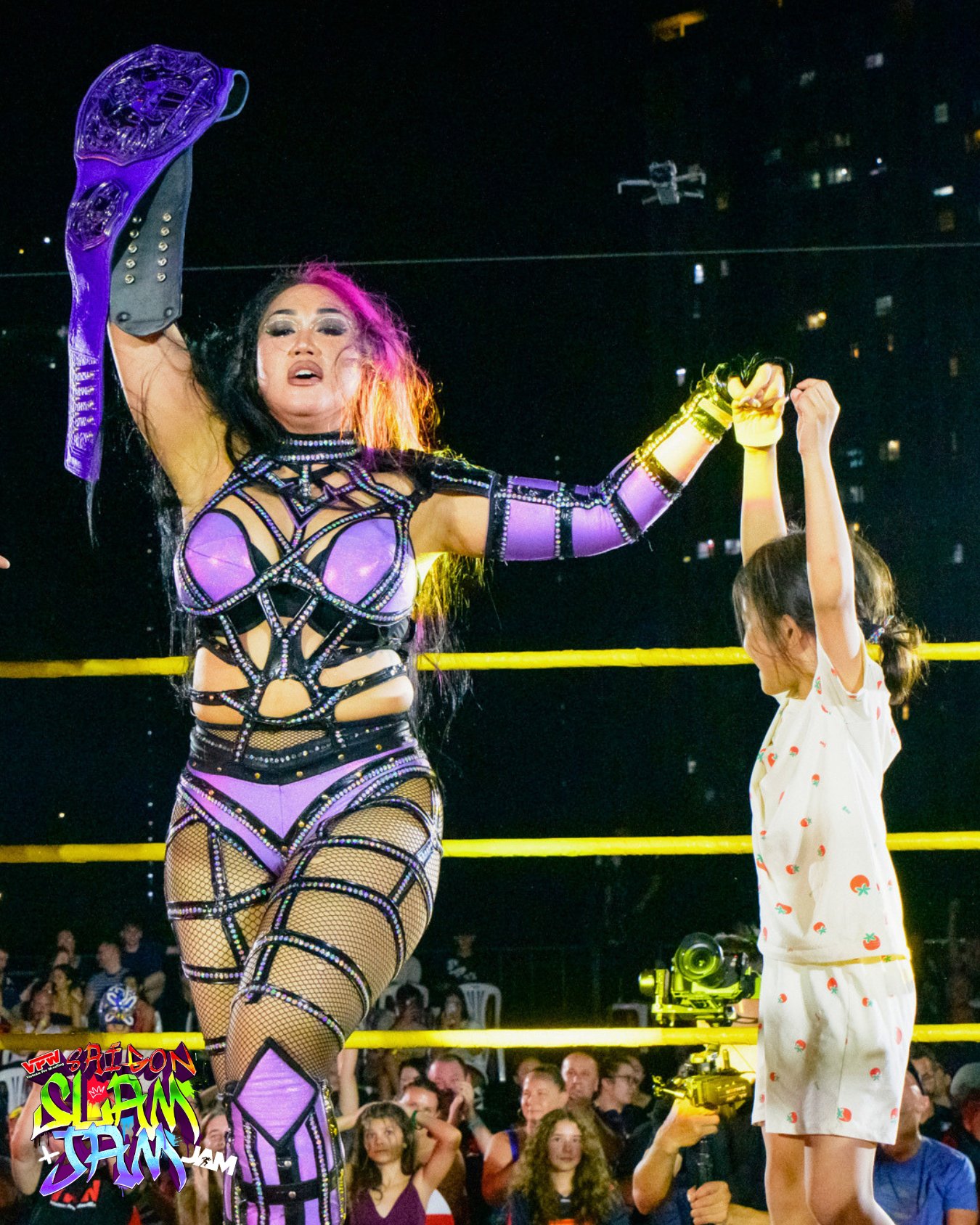
Photo by Aurélien Foucault, c/o of Vietnam Pro Wrestling
It’s a small moment, to some: a between-matches formality at a regional wrestling show most of the world will never hear about. But Wass doesn’t treat it that way.
Viva Van is the wrestler whose GoFundMe, run with Sumie Sakai back in 2019, paid for the ring that turned a self-taught mat club into an actual promotion. She’s the one who now carries VPW’s name into AEW and Ring of Honor on the other side of the planet. And for one moment in Ho Chi Minh City, she stood next to a kid who got to watch a woman from her own country hold a wrestling championship, in a country where wrestling barely existed when its current women’s champion was born.
“She shows young Vietnamese women that they can pursue professional wrestling too,” Wass says. “In a country where wrestling has traditionally been perceived as something only men do, that visibility matters tremendously.”
Fifteen years ago, there was no ring for that belt to be defended in. Now there’s a girl in Ho Chi Minh City who’s grown up assuming that a champion could look like her.
Somewhere in Bangkok, a wrestler taught by Emi Sakura wants that same thing to be true for a Thai kid who dreams of Tokyo.
Somewhere in Singapore, Andruew Tang is chasing a number — three thousand fans, one room — that would have sounded like a joke to the version of himself standing in the Chara Expo tunnel in 2015. None of this required Japan to invest billions of yen… It just required puroresu to show up in the form of specific people, in excited rooms, willing to teach.
The rest — the bedsheets, the judo mats, the GoFundMe for a ring, the Facebook groups, the years of trainees who quit and promoters who refused to — Southeast Asia built that part on its own.
Article Summary:
- SETUP Thailand sells out in Tokyo: A Thai promotion promoted by SETUP Thailand sold out a venue in Tokyo, marking the first Southeast Asian promoter to achieve a full house in Japan and signaling SEA wrestling’s growing global reach.
- SEA wrestling starts from nothing, grows over decades: From a sparse beginning in 1984 with NJPW tours to scattered gym shows and TV programs, SEA wrestling built momentum through persistent local efforts across Thailand, Vietnam, Singapore, and beyond.
- Mentors and cross-pollination shape the scene: Key figures like Emi Sakura, Fugo Yumeji, Tajiri, and others provided training, philosophy, and lineage, helping SEA wrestlers learn with purpose and adapt Japanese techniques to local cultures.
- A regional ecosystem takes form: Promotions like SPW, VPW, and SETUP collaborate, share talent, and develop a regional pipeline, with Singaporean and Vietnamese crews reaching world-stage opportunities (NJPW, WWE, AEW).
- A new generation, new horizons: Vietnam’s Viva Van and other homegrown talents carry SEA wrestling into major leagues, with goals of national reach and potential co-promotions with Japan to solidify Southeast Asia as a connected wrestling region.
