

Jun Kasai: Time To Live
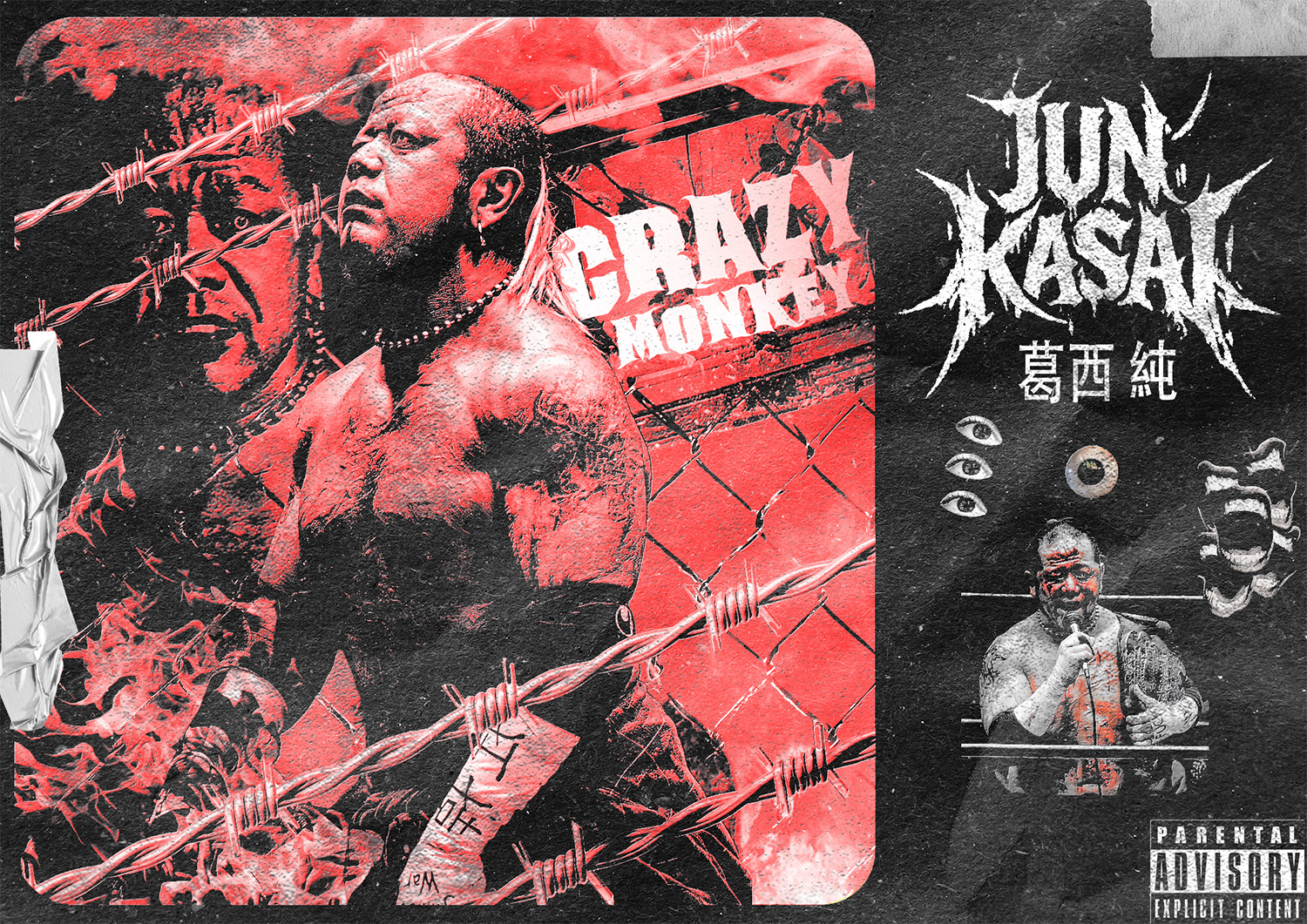
Peatzilla | MP
Jun Kasai: Time To Live
By: R. Faliani
Professional wrestling is an industry built around two concepts: time and evolution. For pro wrestlers to succeed, they must evolve from who they were before. If they don’t, they become stale — often underwhelming to the fans who once believed in them. There are countless examples of wrestlers who never evolved, or never grasped that time is essential to being known on a grand scale — not only because of their literal moment to shine, but because time itself is a filter in wrestling. Unless you assume that rare, rarefied super-stardom status in your territory, there’s no guarantee of permanence. Not in said territory, not in wrestling as a whole. You could be forgotten. Passed under the rug and never seen again, condemned to be a “what if” in history. Your time — your moment — could simply never come. The spotlight could forget about you, or never find you at all. Time could pass, and you could pass with it.
But what if you find your time when everyone has assumed it will never come? What if, after years of struggling with the dooming thought of it is what it is, you decide to cast those presumptions aside — starting to fight for your moment at the last second — and you actually do it?
That’s Jun Kasai’s story: the deathmatch legend who, after 28 years of fighting, bleeding, suffering, and thriving, earned his place in the most prestigious tournament in New Japan Pro Wrestling’s junior heavyweight division, NJPW Best of the Super Jr.’s (BOSJ). Kasai enters this tournament not as a gimmick, not as a comedy act, but as a feared competitor unlike any other, and a beloved one, too. His very existence challenges every belief about wrestling we’ve talked about. Because as a 51-year-old veteran, it seems like time simply cannot catch up to Kasai’s passion and drive. It’s worth examining how a career as legendary as his still feels incomplete to him — even as it has been documented and celebrated in ways that stretch beyond wrestling itself, to the point where figures like Hideo Kojima know his name and respect what he has given to the industry.
But why is entering the BOSJ such an achievement for Kasai? Why are we so surprised to see him competing against the very best? To understand the importance of this moment, we need to go back in time — to an era in wrestling that is sometimes convenient to forget, but which is essential to understanding many of the stories that have come to shape this discipline.
In Kyo-En, Jun Kasai’s own documentary, the idea of retirement looms large — seduced by the overwhelming despair of the pandemic era. His thoughts of walking away stemmed partly from a failed matchup against GCW’s Nick Gage in 2020 and a frustrated American tour on the indie circuit. Kasai tried to stay grounded during the pandemic, but a mounting fear began to take hold: had he lost his spark? Was he a prisoner of time, destined to retire to no one’s applause? Filmed and set between 2020 and 2021, the documentary is a raw, honest look inside the mind of a man confronting the possibility that a 22-year career could end in near-silence — no crowd to send him off, no one to witness it. Nippon.com described Kasai in Kyo-En as “the Maestro of Deathmatch,” a man whose “Deathmatch Charisma” had been built over more than two decades of the most punishing work in the industry. All of that could have ended with no fanfare whatsoever. Kasai could have been forgotten. Instead, he chose to carve his own path.
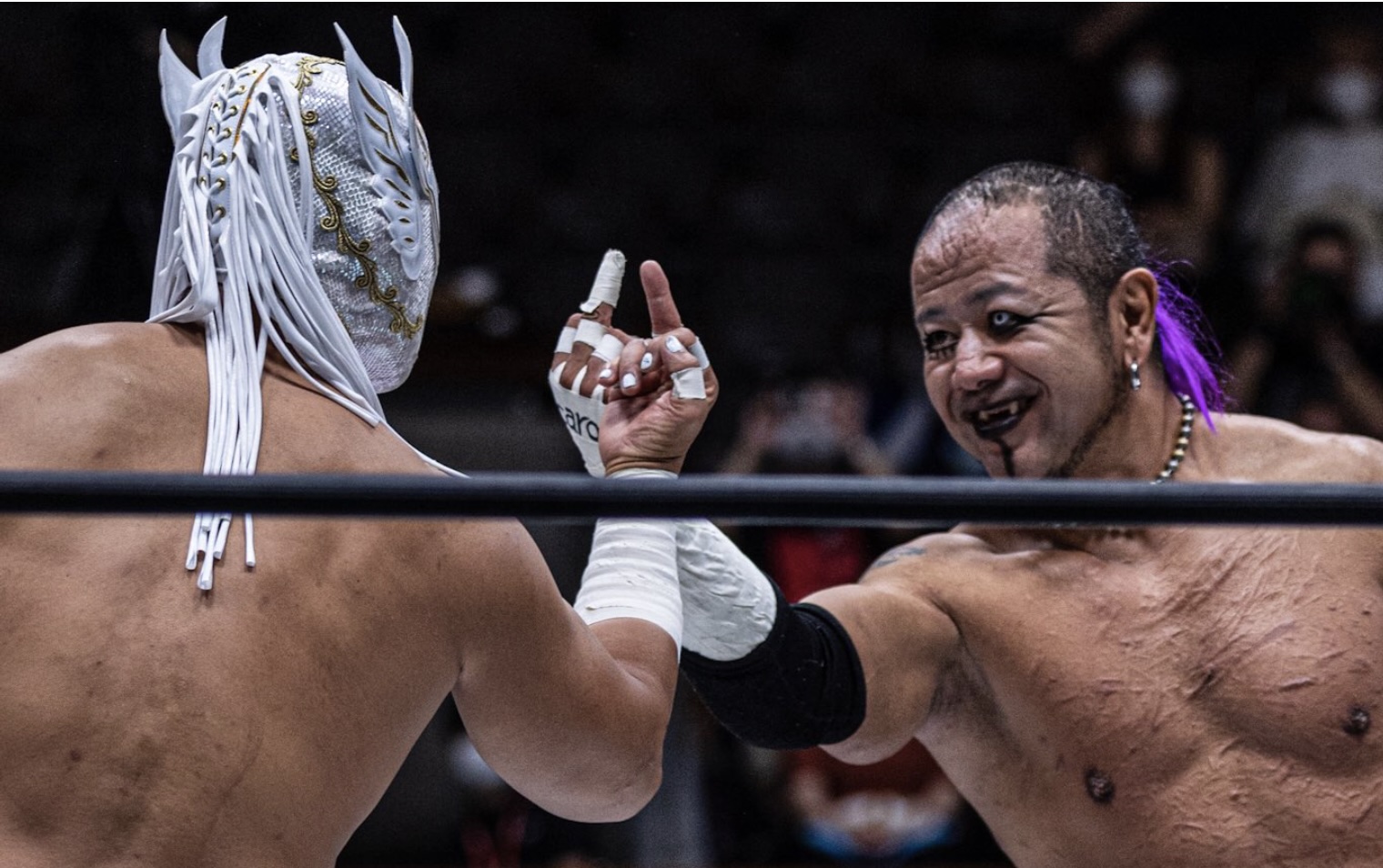
Photo Credit: @taigaPhoto_PW
A year after the realization of that film, Kasai had one of the most important matches of his career — and one of the most important matches to understand the trajectory his story would take heading into 2026 — against NJPW’s El Desperado. This match marked the return of a noisy crowd to the Japanese scene after years of clapping in silence, with audiences unable to scream or cheer for their heroes. We covered this match extensively in Monthly Puroresu when it first surfaced, but the more time passes, the more we see how important it was for both men. We’ve already looked closely at Desperado’s relationship with this match; now it’s time to take a deeper dive into Kasai’s philosophy.
Known to hardcore fans as the “Crazy Monkey” and revered by many as the greatest deathmatch wrestler of all time, Kasai’s career is — fittingly — one of a crazy monkey. Voices of Wrestling ranked the Kasai vs. Desperado match eighth on their 2022 Match of the Year list, calling it “truly one of the most unbelievably violent, wince-inducing, and attritional matches” of the year. Nate Feinberg of Nate Hates Wrestling went further still, awarding it a perfect score and calling the post-match promo “possibly the single most emotional and powerful promo ever,” urging even non-deathmatch fans to seek it out.
In the 2000s, Kasai was jumping from ladders to poorly set-up tables; diving to the outside just because of a banana dangled from a fishing rod; stepping barefoot into barbed-wire ropes; firing a banana-filled rocket launcher; diving from a truck into a burning ring. In essence: doing the most outlandish stuff imaginable, often teetering on the line between spectacle and disrespect — as demonstrated in his historic dive from Korakuen Hall’s balcony onto Ryuji Ito, which earned Tokyo Sports’ 2009 Match of the Year, or in his Big Japan Pro Wrestling bouts during his physical prime.
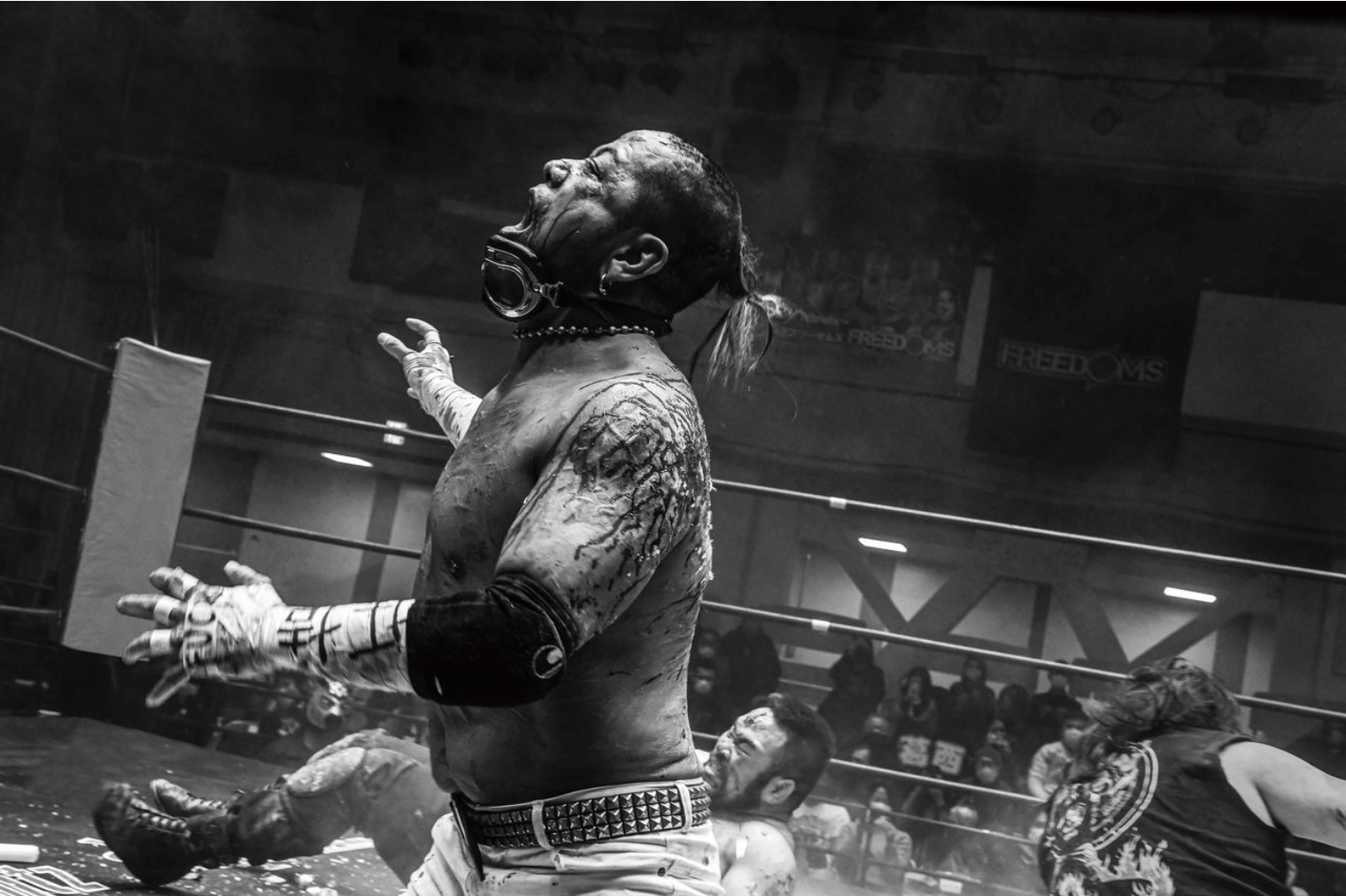
Photo credit: Jun Kasai Movie Project
Puroresu’s relationship with deathmatch wrestling is complicated. Even if some of the most legendary Japanese wrestlers came from a deathmatch background, there has always been a shadow hanging over that world — what Giant Baba famously labeled “garbage wrestling,” a phrase he used to describe any style he felt required little in the way of traditional athletic ability. The division between that world and the “serious” wrestling of the prestige promotions — NJPW, All Japan — ran deep. The 2004 match between Toshiaki Kawada and Cactus Jack for HUSTLE illustrates this tension vividly: Foley arriving with his barbed-wire bat, only to be met by a stoic Kawada whose body language communicated everything about how he regarded both the man and the style. Unless your name was Atsushi Onita — who crossed over into NJPW for a high-profile No-Rope Explosive Barbed-Wire Death Match against Masahiro Chono in 1999 — the idea of NJPW embracing deathmatch wrestling was essentially unthinkable. Two worlds that shall never coexist: that was the common consensus, extending all the way to today. Until something happened in 2023 that began to change that conception entirely.
We talked about the importance of Desperado and Kasai’s 2022 match, but in July of 2023, on an NJPW Strong: Independence Day show, Kasai and Desperado actually teamed up in an NJPW ring — on an NJPW show — against Jon Moxley and Homicide. The mere idea of Kasai stepping onto the cerulean blue was a dream for many, and judging by the crowd’s eruption as he walked the Korakuen Hall corridor, it was clear that something had shifted. Long gone was the perception of deathmatch wrestling as merely “garbage wrestling.” Kasai had made Korakuen — and the cerulean blue — his backyard, cheered by fans and feared by opponents alike.
Fast forward to 2025, and both Kasai and Desperado shared the ring twice in the same year: once in a three-way dance alongside the “Crazy Kid” Masashi Takeda — another historical deathmatch figure who also appeared on Despe Invitacional, Desperado’s own produce show — and again in a deathmatch for the IWGP Junior Heavyweight Title at the Death Pain Invitacional, also held at Korakuen. Voices of Wrestling ranked that final contest ninth on their 2025 Match of the Year list, writing that “no genre of match, when properly executed, is more reliable at eliciting emotion than the deathmatch, and this was the best deathmatch ever seen, with Jun Kasai being one of the most ingenious wrestlers in history in terms of how he paces a bout.”
Despite Desperado retaining the title, Kasai was no loser. After the match, both men promised to face each other one final time — ten years in the future, as two bitter old men, bonded through violence and blood. And in the aftermath, Kasai delivered perhaps the most resonant promo of his career. The philosophy at its heart — what Voices of Wrestling titled “No Need to Welcome Death” — was addressed not to Desperado alone, but to everyone watching:
“Before we fought, you said you didn’t care if you lived or died in this ring. Don’t be a fool! Death should be welcomed by no man. There are countless who yearn to live but are doomed to an early death. Here you are, surrounded by friends, cheered on by this massive audience. You’ve fulfilled your dream of joining New Japan, rose to the highest ranks of the junior division, you’re living your best life possible! So don’t tell me that you’d gladly risk it all, you fool!”
We talked about time and its importance in wrestling, but Kasai’s words here are a declaration against time itself — against the presumption that time is the only metric wrestling should abide by. He speaks to the salary men, the kids who don’t fit in at school, the people with broken relationships, the abandoned, the forgotten, those who could surrender to time at any given second — and he tells them to keep going. Keep fighting. Keep living each and every day.
Often thought of as a personification of death — or death itself — Kasai’s mindset confounds that image. At 51, he is more motivated than ever before. He may be death personified, but what he wants us to understand is the importance of living. His back, filled to the brim with every scar from every war he has ever fought, is not only a symbol of his perseverance and his will to endure — it is a reminder to all those he speaks to: that even with every flaw crawling at your back, you can still rise, still fight, still reach for your dream. At the last second, when everyone thinks you don’t have it in you — when even you think you don’t — you can always find time to live.
